19th August 2026
One long game was so popular it was played on 2 tables by half of the gamers, noisily venturing into the dragons lair to steal treasures whilst the others built space bases and inventions.
Short starter games for this session were My City now on its third consecutive week and Money a trading up and set collecting game back from session 131.
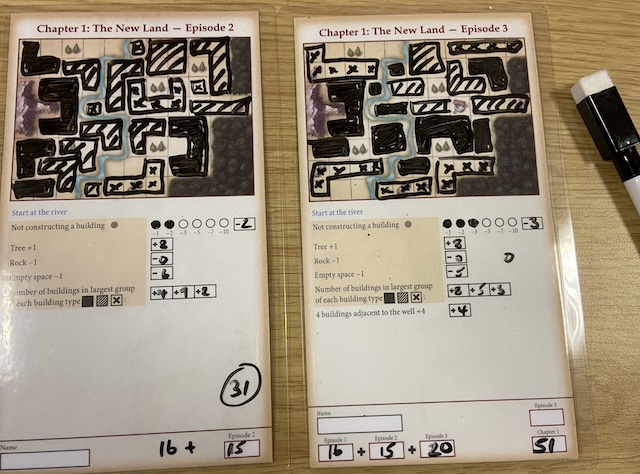
The My City - Roll And Build table managed the first three scenarios before it was time to break out the long games. The first timers struggled a bit in the first round and were caught out with some rocks and empty spaces generating negative scores but they rapidly learned from this and better optimised their pieces in the next rounds. Some good co-localisation of the same building types started splitting the scores more. So the final scores over the 3 rounds were close enough that no one felt they had really failed their town planning but a couple of players had done enough in rounds 2 and 3 to earn themselves some city building credentials.
Then we managed to work out enough pieces from a single combined Clank! box (to reduce the number of boxes to carry!) to play both original Clank!: A Deck-building Adventure and Clank!: Catacombs with a few expansion set parts thrown into both.
Classic Clank! with one of the starter game maps but with Adventuring Party characters Monkeybot prime, Garagnir the orc and D’Allan the eleven collector, to give some asymmetry, and some cards mostly from the Egyptian themed expansion thrown in. It is a deck building and push your luck game, head down into the dungeon depths, grab as much treasure as you can carry and get out before the dragon damages you too much. However not too many dragon cards were drawn so this game did not have quite the sense of peril as usual made it a gentle introduction for the two new players. It did hamper monkeybot (chosen by teacher Kathy) as he was not being damaged and so not gaining extra permanent actions.
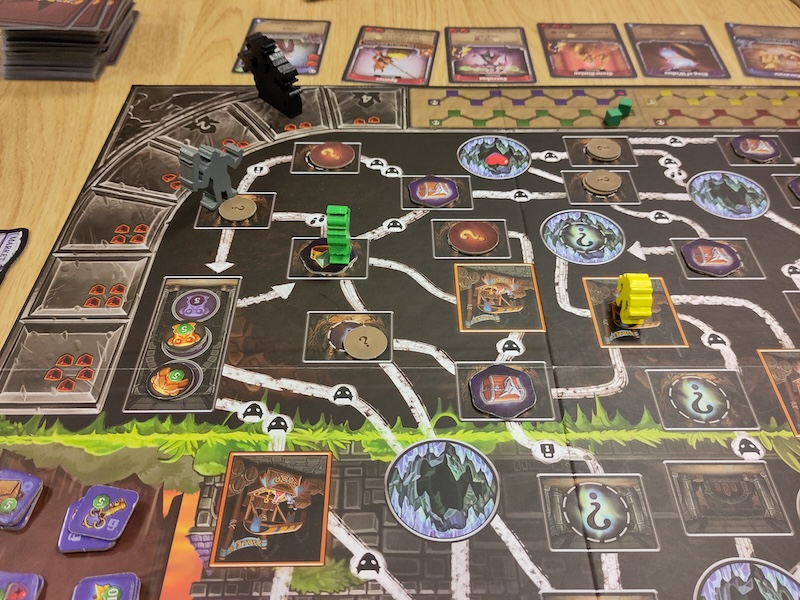
They got the hang of the mechanics after a few rounds and the dash to the depths for the best artifacts commenced. James was doing well acquiring cash and then lots of shop items and starting to trigger his elven collectors bonuses for good effect. Richard was not being too violent with the orc whose abilities trigger by murdering the monsters lurking in the dungeons, but was playing a fairly balanced game and acquiring a good variety of the treasures and cards with end game victory points. Monkeybot was stomping around making a lot of noise and taking the best artifact but only got hurt by the dragon twice when they decided the dungeon was being cleaned out and it was time to get back to the surface.
James emerged only one turn after Kathy and Richard and before the dragons rage really started triggering due to the end game mechanic that causes dragon bag cube “Clank!” draws when a finished player would have had their turn. Scores were fairly close with Richard on 112, Kathy on 120 and James “the collector” on 143.
Iain, Neil and teacher Jeremy were at the same time delving into Clank!: Catacombs with the Lairs and Lost Chambers expansion and with the other adventurers from Clank!: Adventuring Party to spice things up - Neil choosing Whiskers the cat, Iain venturing forth with Agnet the Dwarf and Jeremy was helped by Lenara the wizard.
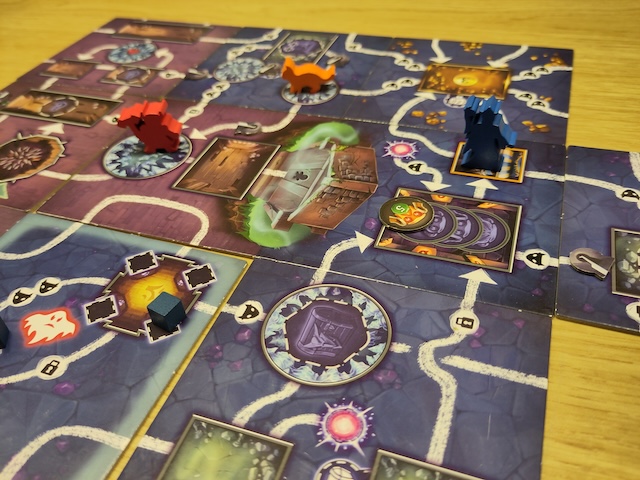
This is very much a similar game to the original - build your deck to improve your skill, might and speed, and then use these to explore the catacombs and find treasure and defeat it’s denizens whilst avoiding the ghost dragon by not making too much noise (Clank!). The differences to original Clank! are exploration tiles - so the map is not known at the start and lock picks to navigate the locked tunnels and claim treasures or rescue prisoners. There are also ghost rooms that haunt all the players (by inflicting damage), portals to skip around the map, and waypoints that can help accumulate gold the more you visit.
Whiskers zoomed off at the start and quickly brought the rage of the dragon upon the others, a naughty side effect of the cats powers. Agnet bravely set forth and was doing a good job of building a skilful deck that allowed her to net several secret tomes over the course of play. Lenara had chosen some rather noisy skill cards that was attracting the dragons ire, but not finding much booty, though a lucky flute helped her purchase a shiny crown from the shop.
Whiskers was the first to net an artifact and enrage the dragon further, and with all the Clank! being made by all three of us, the pain being dealt out was quite even, but harsh. So much so, that Agnet decided with the tomes, a monkey idol and an empty backpack that was enough for today and headed for the exit. Lenara was desperately trying to find an artifact, but they kept disappearing (denizens on the dungeon row kept returning them to the dragon’s hoard), until luck shined and one stayed long enough for a grab and run.
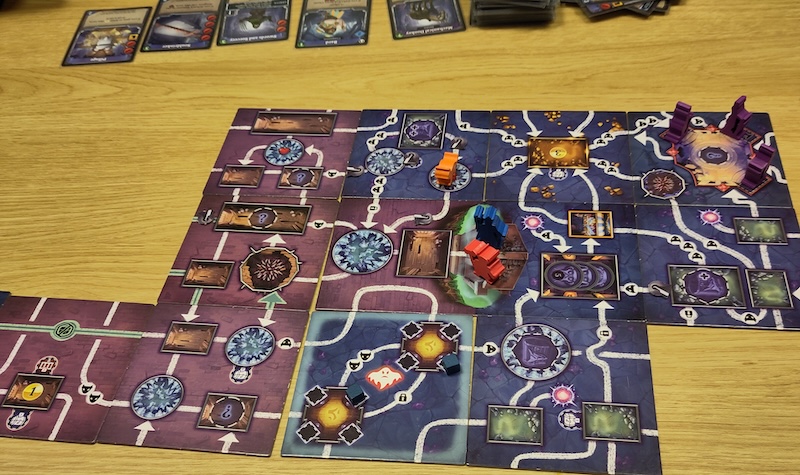
Whiskers was scampering through the rooms looking for a way to pick up a monkey idol to go with a skill card they had picked up. Agnet exited the dungeon which now caused more dragon attacks, hoping that the others would be caught. Luckily for both Lenara and Whiskers the dragon didn’t seem to want to play with them, so they got off lightly even though they had both managed to go to the shop to buy a healing necklace in anticipation. Lenara teleported to the exit next, but Whiskers wasn’t too far behind managing to loot a monkey idol and zip through the dragon’s legs.
In the end, Agnet’s plan of making the others take the brunt of the dragon’s wrath didn’t work to her advantage as everyone got a mastery token worth 20 for getting out. So Agnet’s haul ended up being a tad less than the others at 63, with Lenara’s 88 just pipping Whiskers’ 85 to the top spot. A fun, yet more chaotic game than the original as less planning can be done, but enjoyable none the less.
The remaining players chose Innovation and Space Base.
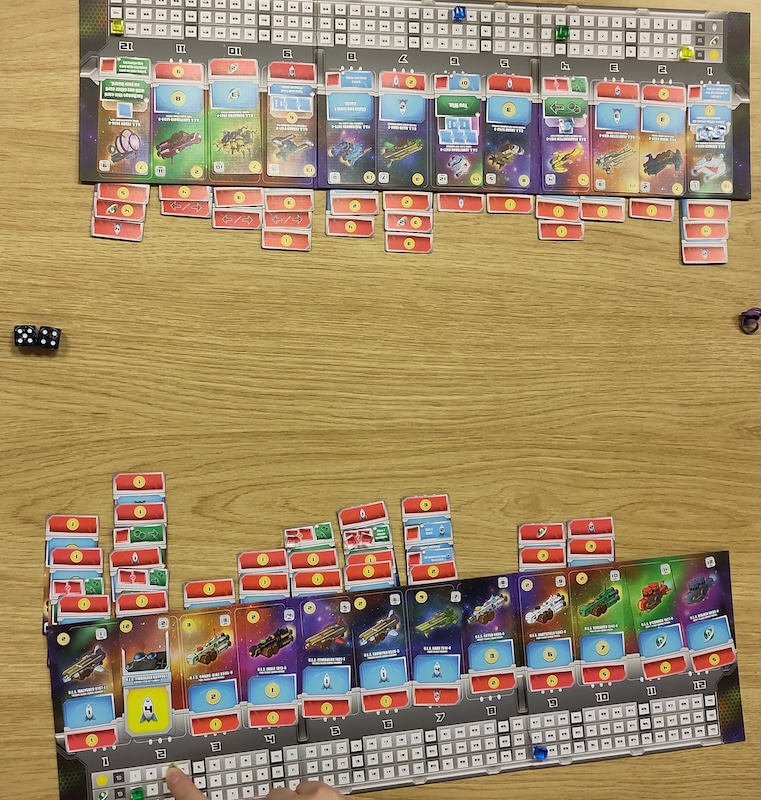
Space Base was back in its second physical appearance from Session 106 having been a BGA online staple back in the Dark Days when contact with other people was a myth. Players are exploring space and building their fleets through the time-honoured tradition of tableau building. Roll a couple of dice, allocate the numbers (either singly or totalled) to gain some points, some cash or increase your minimum income, and if you have enough cash, buy a new ship. The new ship replaces the old one in your fleet of 12, and the old ship card flips to create potential income based on future die rolls. First to 40 points saves face and wins the Space Base Race. Veteran fleet commodore Rich talked new recruits Dan and Darren through the basics and the fleets were on their way.
Ships were being traded at a rapid rate, although points were slow to start, with Dan being the first to actually get his point tracker moving, and Darren realising he’d sent a couple of ships to the wrong co-ordinates - allocating them to the cost figure and not the ship number. Soon after Rich also realised he had also ‘done a Darren’. There was a good mix of hedging bets with upgrading middle ships which were more likely to get rolled with some high-risk strategies based on high end ships being played out. A fleet consists of 12 ships, numbered sequentially, and get activated when a dice roll has that number – so rolling a 5 and a 6 means that either ships 5 and 6, or ship 11 could be activated. When ships have been flipped to accommodate new ships, they have bonuses which will activate when other players roll those numbers. Soon enough Darren had a number of points scoring ships deployed and was racing up the points track – with one minor blip when he thought he was about to buy an extravagant ship to win, only to realise he didn’t have the cash as the card that gave him the cash had extra steps required (some cards need dice rolls to activate slots before they do what they say). He made a swift recovery though, having built a good income base that meant his cash never dropped too low and hit the 40 points to claim the game, with Rich coming in at 27 and Dan trailing at 17.
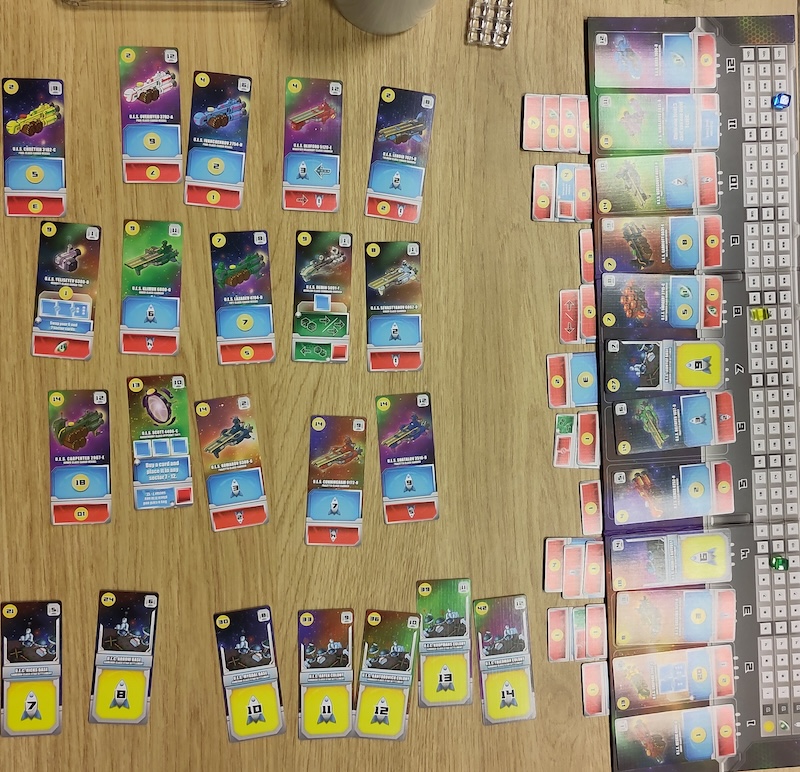
It’s a relatively quick game so a re-match was in order, this time using the option with starting cash available to buy new ships, or just to start with full coffers. Having some shinies in his hand Darren obviously spent all of them on new ships, hoping the point and cash income they generated would lead him to another win. Rich and Dan were a bit more cagey with their money, spending some, but keeping enough back to use in future turns. Rich started with some high ship shenanigans, hoping for some big pay-offs alongside the sensible mid-ship stuff, whilst Dan was playing the averages and concentrated mainly on working up his 6 and 7 ships. Darren went for a high/low strategy building up some nice potential income from 1’s and 2’s and a gamble on 12. Dan rolled a spectacular number of 1’s throughout, giving Darren a steady income to build from, but also managed a lovely little trade that saw a ship with winning potential move from a high slot down into the mid-range. Rolling four 4’s in the game would put 4 cubes on the ship and win, regardless of anyone else’s points. Tense times! Darren had the cash, but was struggling to convert it into points, and Rich was steadily moving up the points, hoping to get to the top before the inevitable. But he couldn’t quite make it, especially with Dan’s cunning deployment of some die-changing ships, and Dan claimed victory.
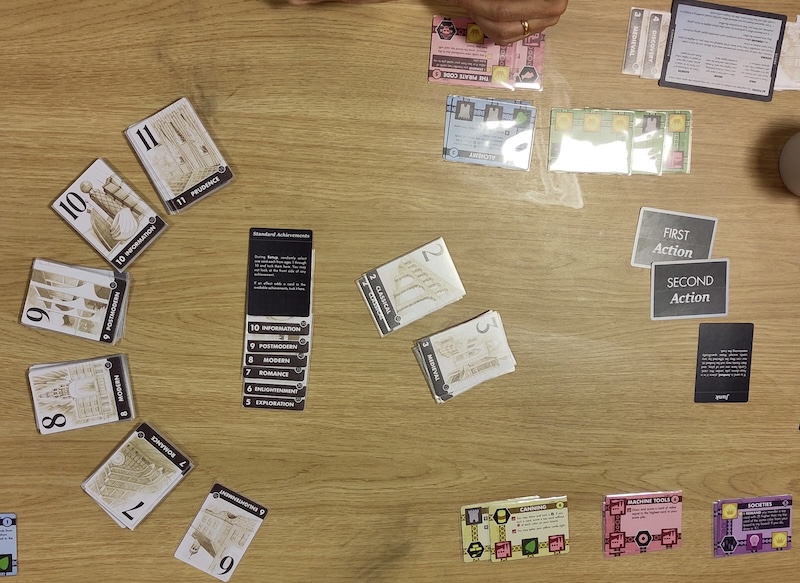
Innovation was previously at club in session 121. It is a card based tableau builder as players work their way up from fairly modest inventions like tools to the internet in later ages.
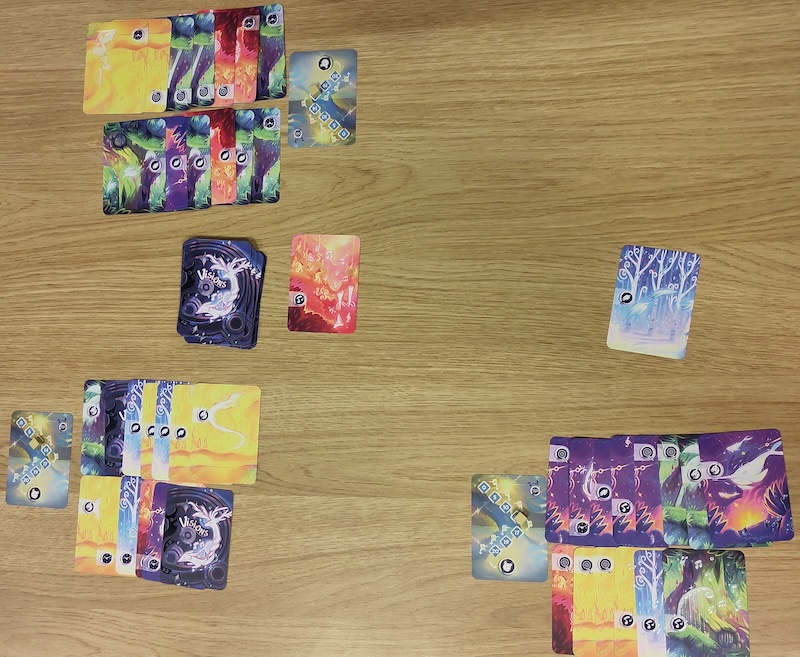
With a little time left after the spaceship shenanigans, the trio of fleet commanders moved their attention from outer space to inner space, and dreams in Visions. This is a light set collection style of game, where players are creating 2 dreams each, by laying cards. Each player has a hand of 3, plays one and draws back to 3. Cards have one of 5 backgrounds and one of 5 categories pictured, so you might have a dragon in the icy forest, or time in the galactic valley. To play a card it must match the previous card, in either background or category, with the two dreams being played one above the other. If a card is an exact match for one earlier in the dream it creates an echo and another card can be played. If the card matches the one either directly above or below it then it creates a reflection which is marked on the player’s reflection card – 1 space for either a background or category match, 2 if both match. A card can be played face down to create a nightmare – this acts as a wild card, and is replaced by drawing a random card from another player rather than the ‘river’. The river is a set of face up cards available to draw from, initially 5, and is reformed when all 5 have been taken, but if an echo is played a new card is added to the river. Scores are calculated by multiplying the highest occurring symbol by the highest occurring background in each dream, plus points from the reflection card. If a player reached the end of their reflection card then they wake up, and they automatically win.
Darren gave a quick run-down of the rules to Dan and Rich, and dreaming commenced. Perhaps too quick a teach, as the echo rule hadn’t been picked up on fully, perhaps hampered by his lack of French – it’s only been released in French so far. It’s a quick, light game, although a few discussions about possible ‘strategies’ were had – whether to try and focus on reflections, or echoes, and whether 1 dream should be focused on more. In the end Rich managed more reflections than the other 2 and woke up, winning the game (by the expedient of gaining 1000 points!). 1060 against Darren’s 64 and Dan’s 42. A very light, quick filler game, with some beautiful cards – and having now found an English translation Darren now knows what BGA did before him about changing card quantities for differing player counts!
Next session is on Wednesday September 2nd 7.30pm at the St Ives Corn Exchange. Join us on Discord to help choose the board games that will be played then.
- Total Session Attendance: 12
-
Board Games: 7