22nd July 2026
Fourteen gamers descended on the Corn Exchange in St. Ives to explore lots of distant lands this session, from Ireland to Arabia and Lost islands to Middle Earth.
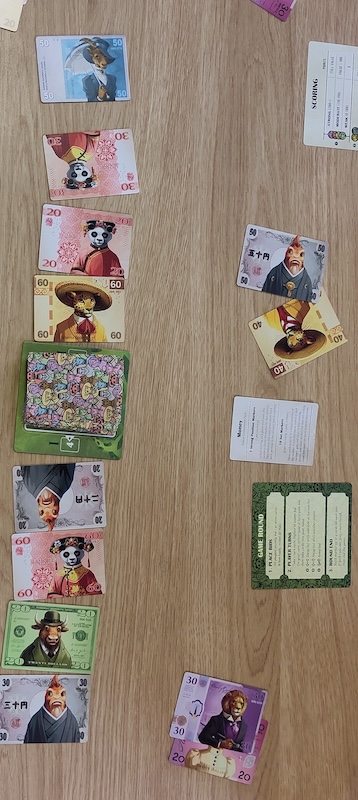
The first short game was new to the club - Money - another game designed by the prolific Reiner Kniza. This is a trading up game, players all start with 6 randomly dealt denominations of money from 7 currencies and two sets of 4 money cards are dealt to the table. Then in a secret simultaneous bid players offer some of their money cards to swap. Starting with the highest bidder players swap their cards for another set either of the two on the table or sets offered by the other players. Once they are done their cards are safe and play continues til everyone has done a swap. The aim is to collect sets of the same currency totalling more than 100 or 200 and triplets of the same currency and value. When the money draw pile is exhausted everyone counts up their sets. With it being a new game a couple of players took a few rounds to work out a swapping strategy. In the end one player had managed some impressive sets and most of the bonus silver and gold cards and was far ahead of the rest. A fun game that will hopefully be back to try again and test some more strategies.
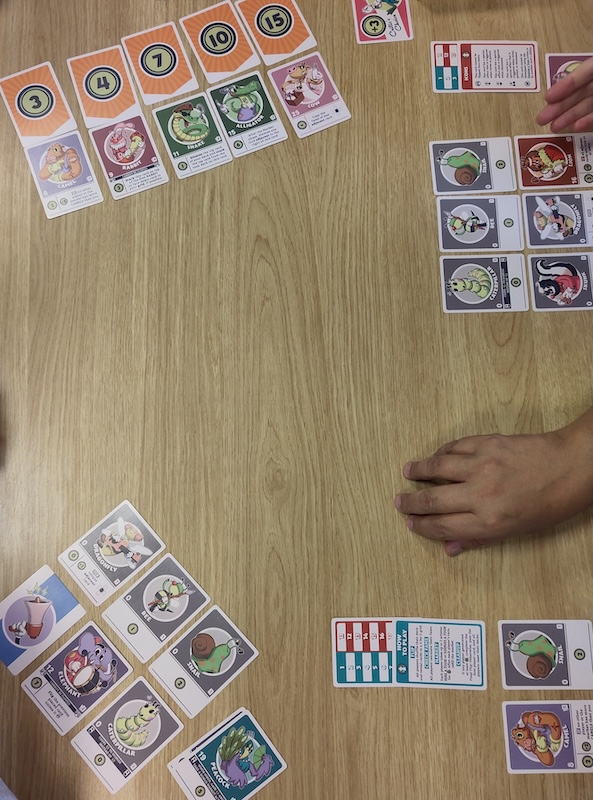
Fliptoons was back for a second short game of cartoon character team building since session 129 - its a deck building game but the trick is to create a all-round good deck so you can consistently get a good score with your chosen cards. Laurence, Reynaldo, James T and Dave played this time with Laurence and Reynaldo being new to the game. Scores were still quite on the low side (less than 20) when suddenly out of nowhere James triggered the end game by getting over 30 points. This was in part due to a gamble he took quite early on by buying a snake card which has the effect of dismissing the top card of your deck and taking a random new card from the toon deck. We went into the final flip and although James only managed a score of 20 this time, it was enough to beat the rest of us who were still busy building our decks.
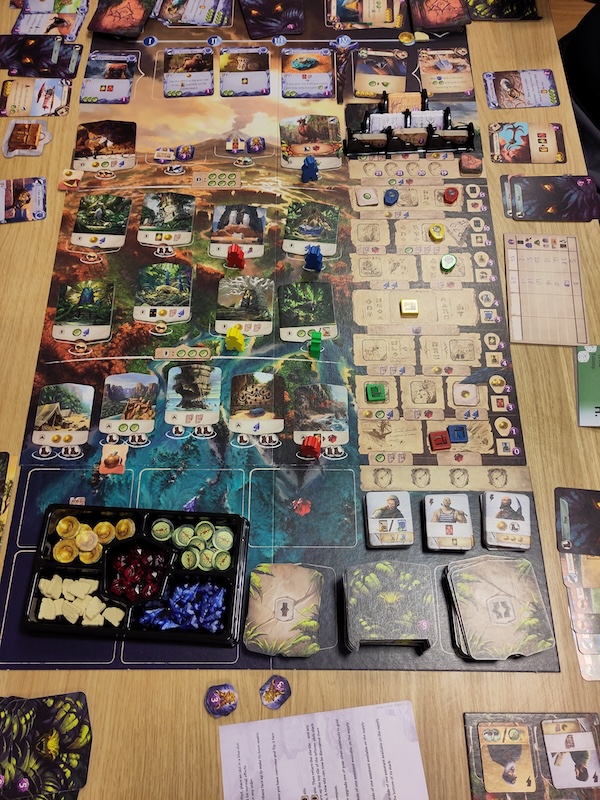
Lost Ruins of Arnak Adventure Chest was back for another play, last played in [session 128]. It is an interesting combination of deck building, exploring and research - which give you a variety of ways to build up your victory points to become the best explorer of the fabled lost islands. Dan, Laurence, Steph and Dave were the explorers this time, playing on the original board but with the Leaders expansion that gives players asymmetric powers throughout the game. Dan (snack boy) chose the Explorer, Dave chose the Falconer, Laurence chose the Professor and Steph chose the Baroness. The explorer only has one architect (worker) but can use snacks to access benefits on cards and visit multiple sites. The Baroness has income from investments and also has a power that lets her buy items and place them immediately in her hand (rather than in the discard pile). The Falconer has a bird track that they can move along gaining increasing bonuses along the way at the point they decide to cash them in. Finally the Professor has access to additional exclusive artefacts and gets bonus resources that can only be spent on artefacts. The new players picked up the rules quickly and in the end it was snack boy who won a close fought game.
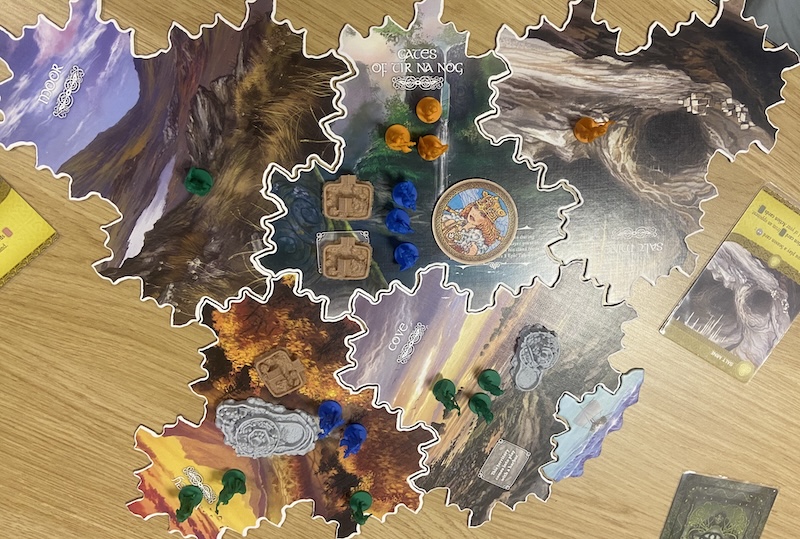
Three players tried Inis, last played in session 35. Inis means Island but also stories in Irish according to Diarmuid the games owner and teacher for the night. It is an area control game with three possible victory conditions relating to having clans present in 6 territories, being in territories with 6 or more total sanctuaries or being a chieftain over 6 opposing clans. Clans can occupy territories peacefully if both sides agree or take over a territory through a clash. At the start of each round 4 action cards each are drafted by the players through a passing on method similar to 7 Wonders. These cards give varying actions including exploring or placing new territories, moving clans, adding to clans, acquiring epic cards, blocking other players moves, building sanctuaries or citadels or having a clash.
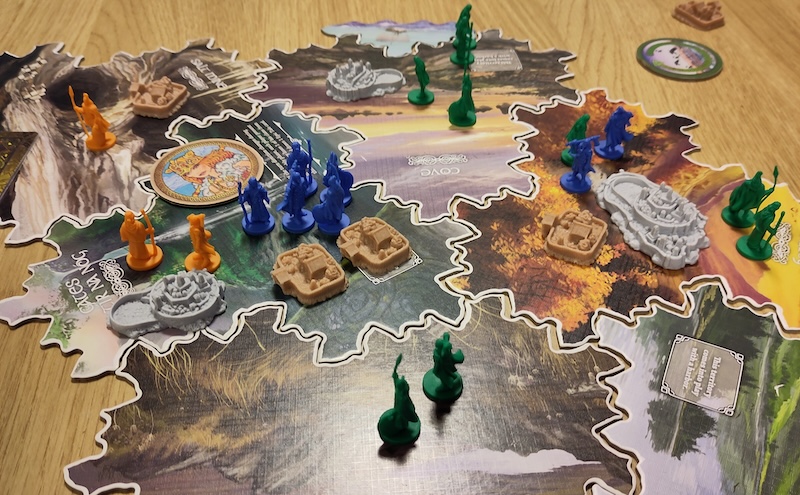
Our game was fairly peaceful, only a few clashes and some diplomacy to share territories. A few epic tales were told like Dagda’s harp and Bran’s voyage. But Dairmuid’s experience led to a decisive victory after an attempt by Kathy to help Reynaldo attack Diarmuid’s citadel by drawing some troops into a neighbouring territory backfired by giving him control of more areas.
Lord of the Rings: Fate of the Fellowship was back for a second play (since session 124). This time the fellowship was made up of Gandalf and Gollum (led by James), Legolas, Frodo & Sam (led by Richard), Arwen and Gimli (led by Neil), and Aragorn and Boromir (led by Jeremy). They had four quests to complete apart from throwing the one ring into Mount Doom (… Mr Frodo).
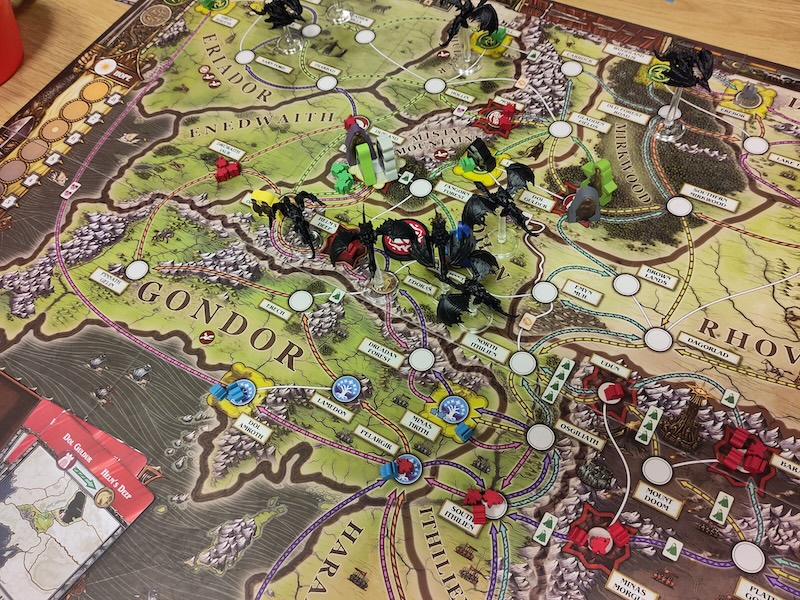
The game started with the fall of Helms Deep, and Frodo being spotted legging it out of the Shire, so Hope was at a low ebb for quite a while during the beginning of the game and it looked like the fellowship might lose. But though Saruman had a quick win taking Helms Deep, he had left Isengard undefended so Gandalf and Arwen walked in and turned it into a Haven to stop any more foul play. Gandalf then had to rush off to Confront the Balrog in the Mines of Moria, so was lost to us for a while (he came back after a couple of rounds, more powerful than before!).
To take back Helms Deep; Boromir brought many troops from Gondor and Rohan, but even with Tom Bombadil’s help his armies were decimated by Nazgul. So it fell to Arwen and Aragorn to bring Elves (and with a little Orc infighting) finally helped Boromir to retake Helms Deep and to break Saruman’s staff!
Meanwhile it looked like Minas Tirith would fall as Sauron used the distraction of Helms Deep to send his orcs out, luckily with the help of Lembas bread, Legolas & Gimli rushed to Gondor to unseat Denethor and rally the troops to protect the city! Shortly after, Arwen and Aragorn arrived and unfurlled the King’s banner. Hope was at an all time high!
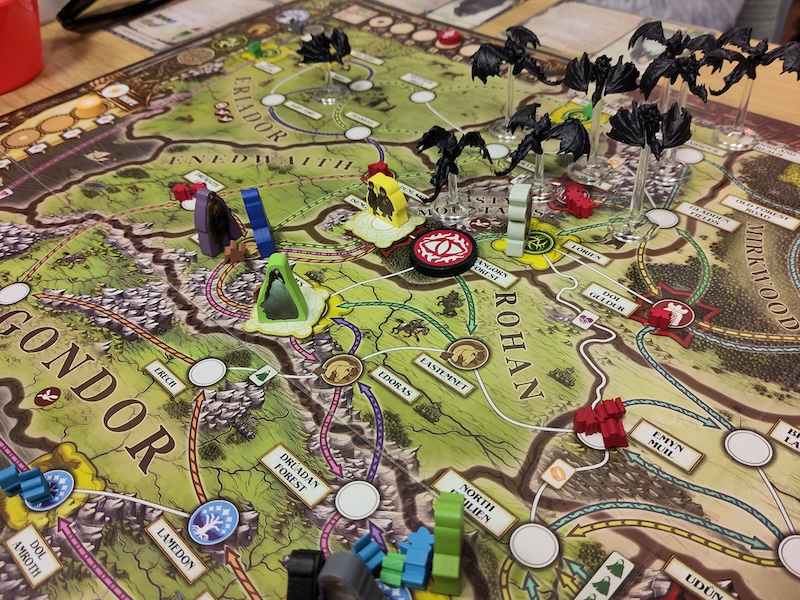
Unfortunately Frodo and Sam had been left in the Misty Mountains on their own and all the Nazgul had found him and the eye of Sauron was squarely focussed on him too. They had to evade multiple searches which sent Hope crashing back down to nearly zero. (It involved the use of some precious rings to avoid Hope being zero, which made the final quest more difficult).
With all the quests but the One Ring complete, the fellowship then concentrated on helping Frodo obtain more rings and to finally meet up with Gollum and sneak into Mordor. Unfortunately time was running short (the player deck was nearly exhausted), and so were the rings (we needed 5 to complete the final quest), when disaster struck, Sauron in a cunning switch of troop movements sent his Orcs not to Minas Tirith, but to the Woodland realm, where there were no defenders (or fellowhship as they were mostly in Gondor)! Hope was lost and so was the game as the realm fell to the dark one.
In the 8th and 9th centuries CE Baghdad: The City of Peace was a thriving cosmopolitan metropolis, attracting scholars and scientists from around the globe, becoming the largest city in the world and a hub of trade and innovation. In this game (from the designers of Shackleton Base and Autobahn) players take on the role of viziers helping to build and improve the city, using the time-honoured methods of worker placement and hand management.
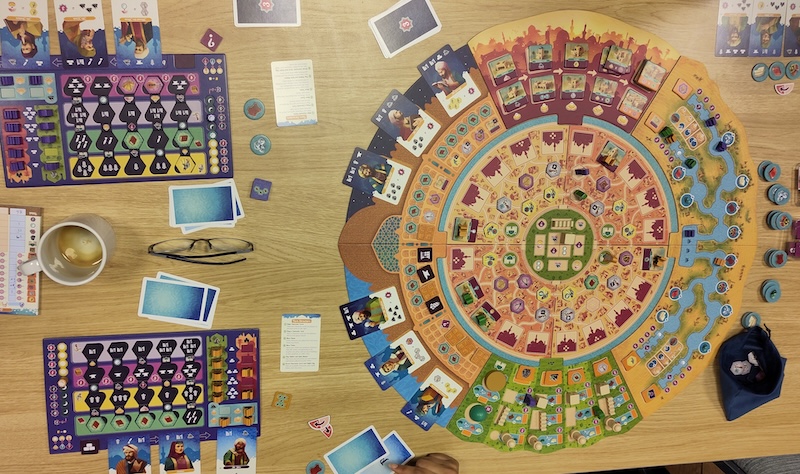
The main board is a lovely piece of work featuring a rondel for player movement and buildings forming the City Area, surrounded by the River, Building, Palace and Wisdom Areas, with the grounds for building the palace in the centre. Player boards are slightly asymmetric, with spaces for collecting scholars, patients, books and artefacts, along with holding your boats, houses and architects, a shame/favour track, and spaces for your played cards. Viziers move from one quadrant to the next on the board, with choices between taking on patients for resources, housing students for future skills, finding artefacts for points or collecting books for bonuses (and just because they’re books obviously – getting books is good in games and life). You move to the space and put the tile you’ve landed on in the track on your board for that thing. Simple. Oh, except each space has a skill requirement, and the skills are shown as icons on the cards you have played. So a little bit of planning required.
There’s also the option to help build civic buildings or construct parts of the palace - as a vizier you’re getting involved in the city’s infrastructure, not just it’s population. And all these actions require you to have the relevant skill icons visible on your played cards – you start by playing one, play another each turn, but they slide along each turn with only three spaces. So you’re planning your moves around which cards you’ll play to ensure you have enough icons to make your move. Simple?
Each card also has an activation bonus or score on it, which is activated when it slides off your board. As long as you meet the requirements on the card. So you’re planning to have met the requirements 3 moves after you’ve first played the card. Not quite so simple. Especially in conjunction with the above planning. And let’s not forget that as a vizier you are expected to help out the citizens of this great city. So if there’s a student in an adjacent space, you’ll help them pay their tuition fees with a coin. Yes, money can be a little tight since you asked. And if there happens to be a patient in an adjacent space, well, you’ll gladly pay a favour to help them. The favour track has 4 positive spaces, negative spaces create shame, and shame loses you points. So maybe there’ll be some planning around which spaces you move to. Simple?
You also have some boats – well 1 to start with, but you can buy more with that ever-plentiful supply of money that you haven’t spent on students. Boats can move if the card you just played has a boat icon showing, and they’ll pick up goods on route to one of 4 ports, where’ll there will be an opportunity to trade. Why 4 ports you ask? Well, each of those ports has a scoring tile beside it – each boat you have in a port will score you a multiplier for that particular score. Good question at the back there. Yes, it’s a multiplier, so if you don’t have a boat at a certain port you’re not scoring that one. That same scoring mechanism is also at play with the palace construction. There are 4 columns of palace parts, built by placing an architect beside the part (along with paying the resource cost, and of course assuming you have enough brick icons to move an architect). Each column has a scoring tile at the bottom, and your architects will multiply that score. So 8 potential scoring tiles, with space for 3 or 4 player pieces at each – you’re not scoring all those, so you’ll probably have to do some… planning. Not sure we can use simple any more.
As an added wrinkle, filling adjacent column spaces on the player board gets a bonus, but each space has a different skill requirement, with this being where the player boards differ slightly. Yes, that’s right. There’s some more planning involved there. If you wanted an easy life, why did you become a vizier?
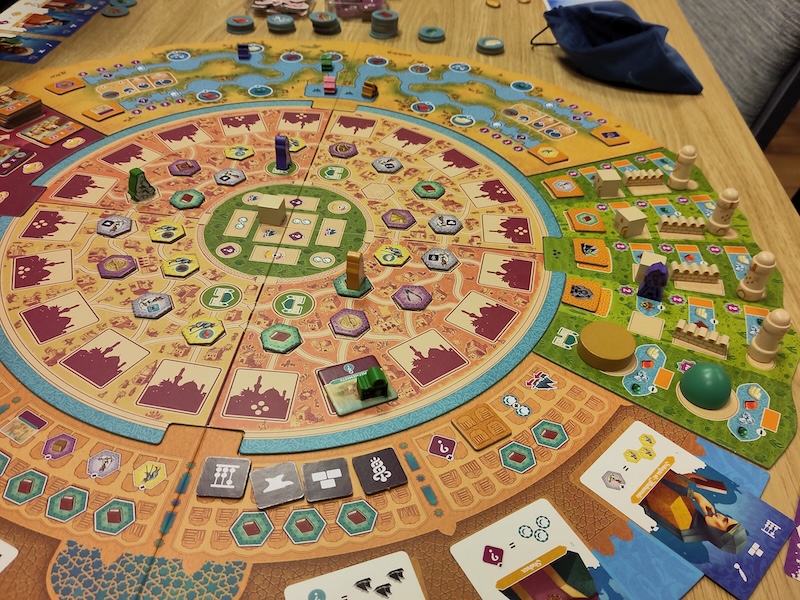
Jyo, Darren and Simon had decided to take on the challenge of running the City of Peace, partly fuelled in an effort for Darren to get the rules locked in before teaching it again at the weekend (Manorcon). A reasonable teach was required to make sure all the parts were covered – the actual play isn’t that complex, but the planning can be, and so you really want to know what all the bits do ahead of time. Even so there were several “Ohhhh, I see…” moments as the game progressed.
Early moves saw Darren and Simon getting some boat action going in order to pick up some goods, whilst Jyo started in on getting some buildings up. With a building in place, every time your Vizier visits that quadrant they can activate the building for a little something, so early buildings can be very helpful – although then you’re also planning on whether you want one really good quadrant, or a little something at each. Other than sailing boats Darren was picking up some artefacts – initially just due to the fact that they were in positions that didn’t require high favour or gold cost for patients/students, and Simon going for a bit of a mix as he pieced it all together.
The first few cards to slide off the end were from the starter sets, so were giving little bonuses with no requirement, but as they switched to other cards (at the end of your turn you pick a new card into your hand from the displayed 6, giving you a hand of 3) the whole planning thing started to make more sense. Simon had decided buildings were a good thing with those bonuses, and was focusing on 1 quadrant – you can acquire step markers that allow you to skip 1-3 quadrants when moving, which can be very helpful when you realise the next quadrant is full of students and patients. Jyo’s library was increasing, and this was granting her several bonuses as it did so. Darren was spending cash as soon as he gained it to build up a fleet of boats, sending most of them toward the artefact scoring port.
A few pieces of the palace started to get built, and around the same time there was a general increase in muttering, head-scratching and soft cursing. The character cards you play come in two flavours other than the starters, day cards and night cards. If you meet the requirement on the day card you get a nice bonus, maybe some gold and a step token if you have 3 patients when it slides off, whereas the night cards will score if you meet their requirements, maybe 8 points if you have 5 students. A few cards were now starting to slide with no benefits forthcoming. Darren at this point made several errors where there was a plan for a particular card, and then something shiny had been spotted elsewhere making him forget the plan. Pivoting is certainly possible in this game, but as with everything else, it requires some planning to do so. Unexpected move in the planning area doesn’t bring an assistant running, it just brings a lack of goodies and a vague sense of failure. His stack of artefacts was worrying the other two though, with several remarks about the lack of teacher’s curse and some inevitable crushing. It should be noted Darren himself did not share this confidence in his scoring ability.
Jyo meanwhile, was gradually adding more pieces to the palace, getting some nice bonuses from placements, but more importantly getting her architects in scoring positions. All three players were by this stage wondering if students and patients really deserved their gold and favours, as they seemed to have settled adjacent to every space anyone wanted to play in. Simon was collecting step tokens wherever he could in order to fast track around the city to the quadrant heavy with his buildings, blatantly ignoring the pleas from said students and patients.
As the planning and head-scratching subsided the score-multiplying spaces looked a little sparsely populated, and questions were asked about the choices made – mainly in the game, but some about life in general. In the end Simon’s buildings and Darren’s artefacts left them pretty close, with 65 and 63 respectively. Jyo however had reached the giddy heights of 99, crushing the other 2 viziers beneath her bejewelled sandals by scoring well with books, patients and architects, as well as a good showing from scoring night cards.
All in all, a beautiful looking game, with mechanics that make sense as soon as you start playing but involving some tight decision spaces and just a little bit of thinking. Just need to do a little bit of planning. Simple, right?
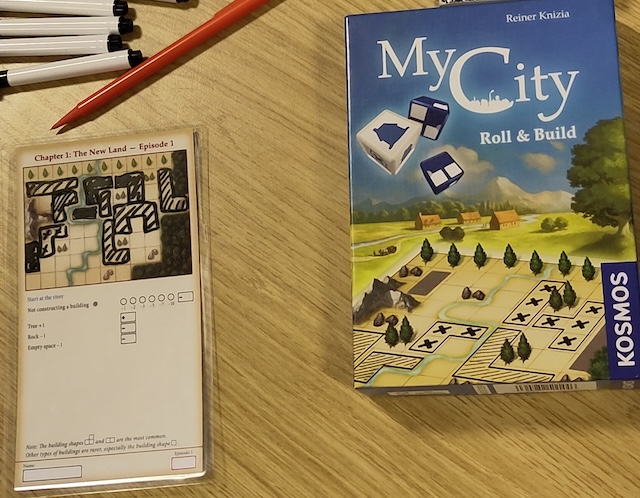
A new roll and write game for club My City - Roll & Build, also by Reiner Kniza, to finish the evening. The 3 gamers tried the first 3 scenario’s which gradually introduce the concepts. Dice rolls set which shape (and type of) buildings need to be fitted onto the player grids, around the river and trying to avoid trees but cover boulders.
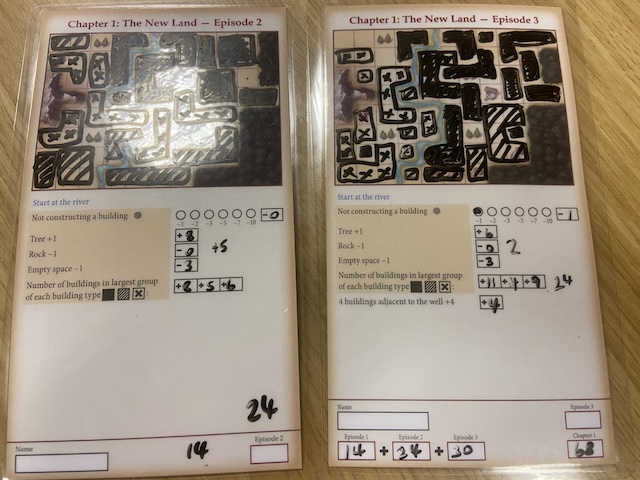
The second scenario introduces building types and trying to group the same type together for bonus scores. While the third scenario introduces a well with bonus points for placing 4 separate buildings around it. A simple concept for the end of the evening with all players having the same opportunities. Whilst there were a few swings in scores between rounds the totals across the 3 rounds were quite close with only 3 points separating first and last places.
Next session is on Wednesday August 5th 7.30pm at the St Ives Corn Exchange. The Discord server starting a few days before the session is a good place to see which games are being suggested and bag a seat at the table or request a favourite game to be brought along on the night. Otherwise there a usually a couple of spontaneous tables decided on the night from the games brought to share and teach by members.
- Total Session Attendance: 14
-
Board Games: 7