4th March 2026
A mix of new and returning games this session with an emphasis on exploration and habitats but also inventions and illegal activities.
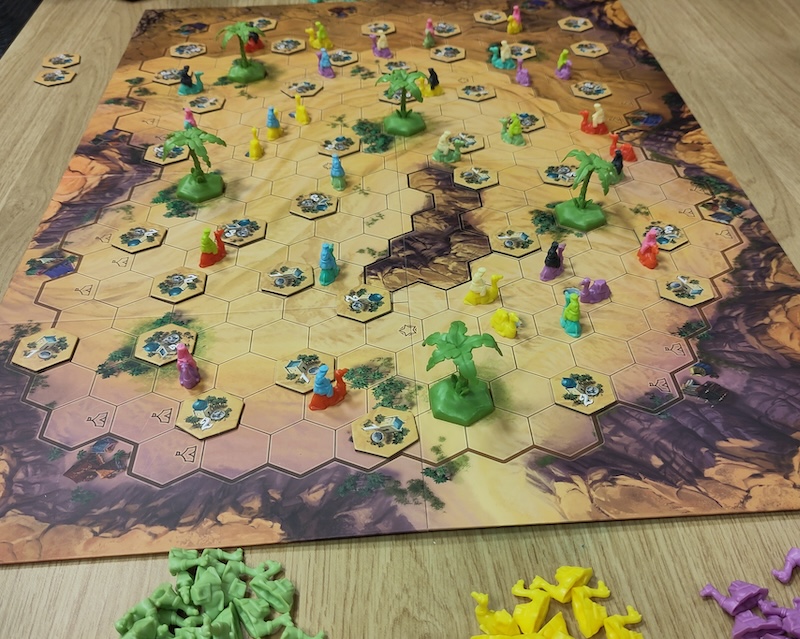
Five nomads sat down to lead their camel caravans Through the Desert in a bid to claim oases and territory. In typical Knizia fashion this is a game of few rules but plenty of strategy. Camels come in 5 different colours in this game, with each player having 5 caravan leaders, each sat on a camel of each colour. By linking caravans of corresponding camel colours players are trying to link to an oasis, a watering hole, or enclose an area of the Sahara, represented by a good old hex map.
Initial leader placements were a mix of what appeared to be well thought out spaces and some purely random picks, tempered somewhat by the placement rules – can’t start in a scoring space or adjacent to another leader. Once the leaders were all placed turns consisted of playing 2 camels of any colour, in order to extend your caravans. Visiting a waterhole claims you that scoring token, reaching an oasis gets you a 5 point token (each caravan can only score an oasis once), and if you manage to entirely enclose an area with your caravan you’ll score a point for each hex inside that area during end game (providing you have enclosed an area free of any other camels). End game scoring also awards points for the longest caravan of each colour.
Early moves were mainly focused on grabbing points from oases and water-holes, simple enough, except for the wrinkle that one player can’t place camels of a particular colour next to another player’s camel of the same colour. James T started to cut off one corner of the map, with no-one realising until it was too late to block it effectively, Julie was meanwhile grabbing watering-holes, Darren claimed one small area, Richard was trying to get some long caravans in place and Dave was complaining about how little space there was for manoeuvring in a 5 player game (although it turns out that we should have only used 4 leaders in a 5P game).
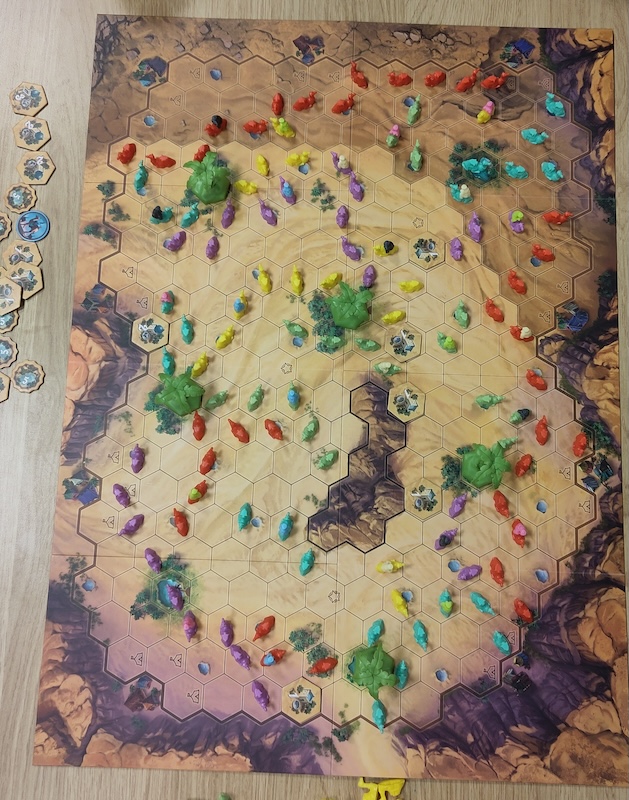
Game end is triggered by placing the last camel of any colour, which James did mainly in a bid to stop others continuing to score and hoping his claimed area and long red caravan would net him enough points to win.
Which they did, at 61 points narrowly beating Julie on 58, Darren just managing to claim an area at the last moment to gain 3rd place with 52, and Dave and Richard finishing on 42 and 34 respectively.
A deceptively simple game with a lot of opportunity for different strategies, an easy teach and a short play time.
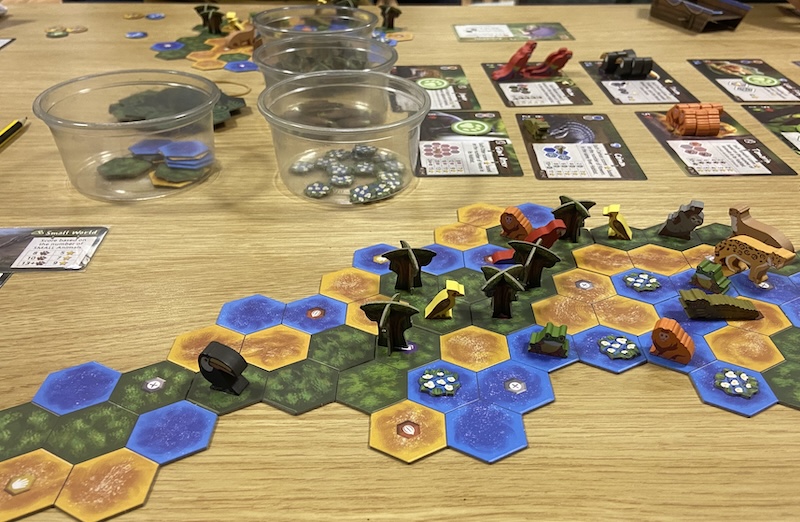
Life of the Amazonia was next setup to ensure a teach and play would also successfully conclude, it was back from session 107. Kathy J. taught 3 Amazon ecosystem novices the rules for this bag builder and soon the habitats were growing and being populated with trees, water lilies and animals. A few rounds in everyone had the hang of the mechanics and began to understand the importance of composting to improve the tokens in your bag to try and get the right mix out to be able to place the larger animals or expand further, as costs rise the bigger your ecosystem is.
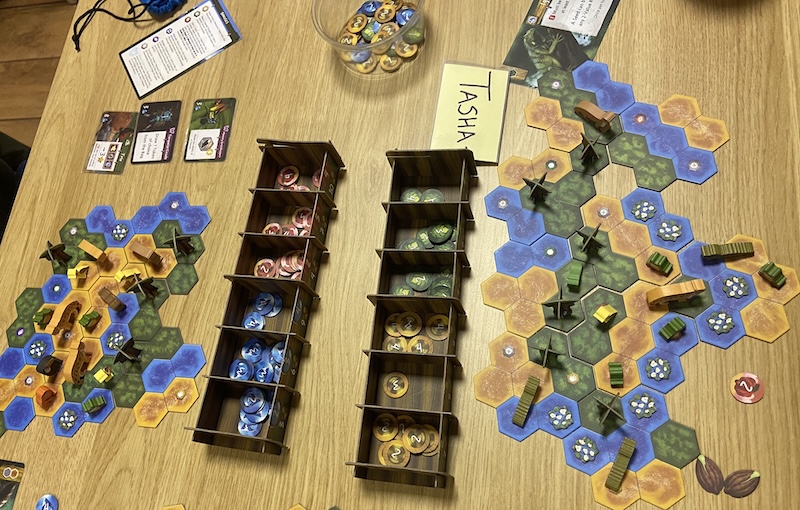
In the end Jack, with his unique Anaconda starting animal, and focus on jaguars was the winner. Then it was very close between Natasha the Iguana who had focused on caimans and Neil the Armadillo and his cacophony of woodpeckers. Leaving Kathy the Sloth in last place but content with her varied ecosystem with at least one of every animal. All enjoyed the game and the nice artistic design and variability in ways to score the 8 animal types and would play again.
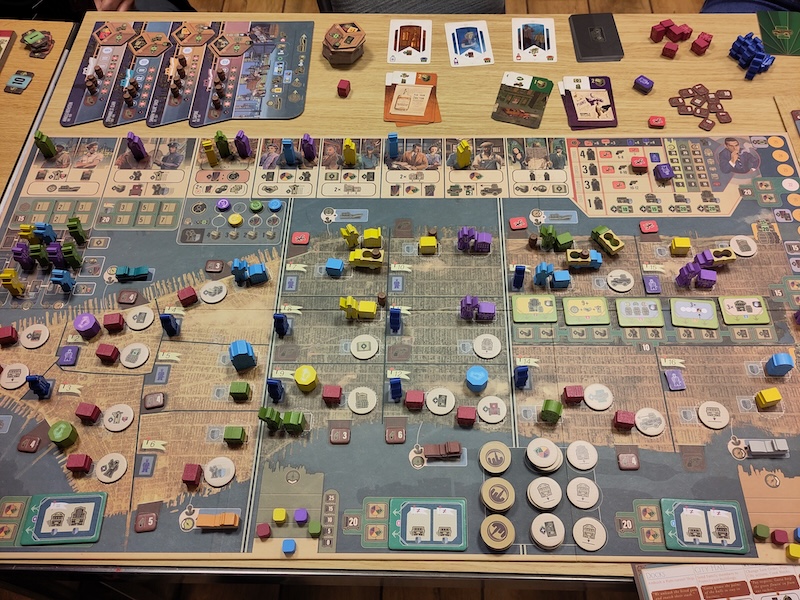
Speakeasy was being setup first, as was proved at last session, this is a table filler and a long game. This week it was Steve and Iain’s turn to try out the latest Lacerda title alongside returning players Jyo and Steph. Jyo got off to a flying start and raced up the infamy track, clearly meaning business. Speakeasies were built, rum runners were ambushed and control of Manhatten was hotly contested. Mistakes were made; Steph failed to protect her stills from the attention of the local cops, rendering them non-operational for the central part of the game, and Steve’s newly-built casino was lost when he overlooked an upcoming mob war (to much wailing).
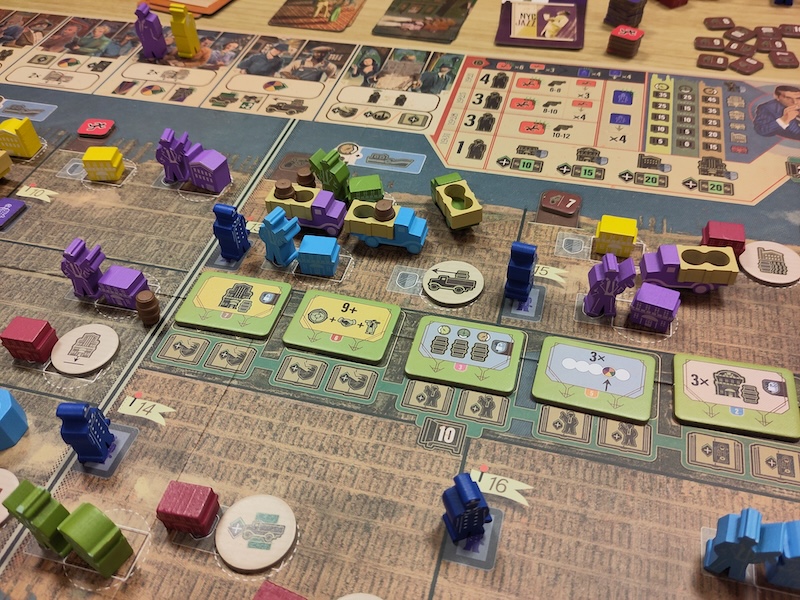
As the final act approached, Iain was cooking the books to stuff as much cash as possible into his safe and Jyo had a huge last turn, selling rum to her nightclub and casino network for massive profits. Unsurprisingly, Jyo was counting her final money pile for much, much longer than anyone else and ended on a very impressive 519. Steph and Steve scored in the 300s while Iain brought up the rear with a respectable 192, and immediately asked when we could play again.
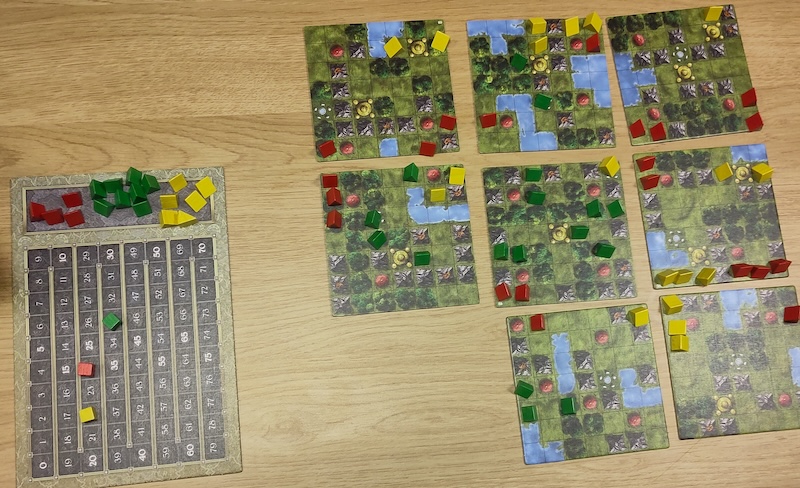
Simon arrived with his Sport-Billyesque bag of games as another table had finished, so with a bit of people-shuffling Dokmus arrived on a table for three – having last been played in Session 82. This is a fun spatial puzzle game, lightly themed around exploring your tribes ancestral island home with help from the Guardians of said island. The board consists of eight 7x7 map tiles which are laid out in a 3x3 grid on the table, leaving the middle space empty. Each map tile has a mix of meadows, mountains, volcanoes, temples, forests, water and ruins, which each affect movement and placement of your 25 pieces.
After placing your initial piece on the outskirts of the island you then spread out, 3 pieces per turn, from that starting point, trying to claim temples and ruins, across as many tiles as possible. The 5 Guardians provide special powers to aid your expansion, such as rotating or sliding a map tile, moving one of your already placed pieces or changing player order – at the beginning of each of the 8 rounds the guardian cards are drafted, so each player has 1 power to use on their turn. Expanding across forest, volcanoes and water all require the sacrifice of 1 piece, but there are potential points for sacrificing the most pieces at end game.
It wasn’t long before coloured triangles had spread across the tiles, with Darren making an early bid to get pieces on all 8 tiles, whilst Simon and Julie focused in on claiming temples and ruins. Plenty of shenanigans were instigated, involving the moving and rotating of tiles to aid or hinder, although it was quite a while before anyone claimed a change of turn order to stop Darren getting first pick of the Guardians.
It was a close-run thing, but in the end Julie’s temples managed to gain her the win with 52, Darren just 1 behind on 51 and Simon with 47.
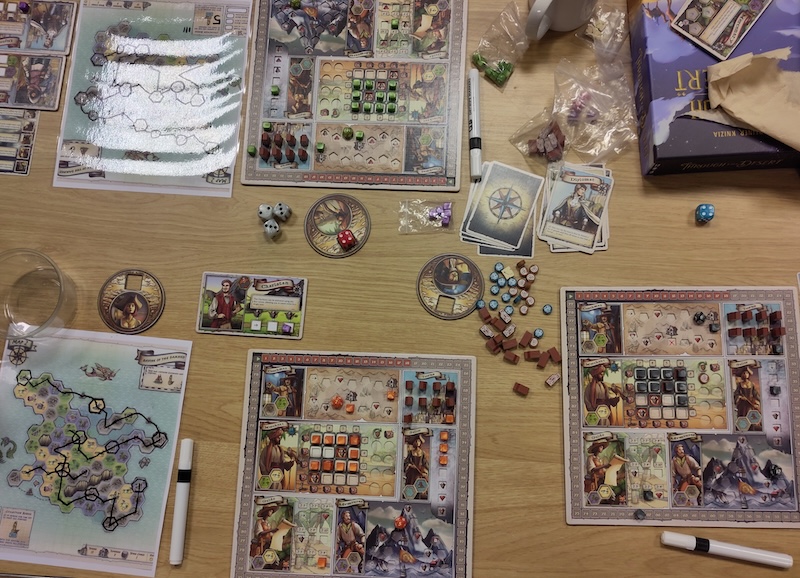
After completing their first game of the evening, Dave B, James T and Jeremy J settled in to play Wayfarer’s Tale: A Journey Begins. This is a roll and write game produced by Wayfarer games and is a re-imagining of a print and play game that came out in 2023 (and was runner up for best print and play game that year). The new version was kickstarted in 2024 and is really only available directly from Wayfarer games.
The game includes four different maps which contain slightly different rules and objectives and of course new landscapes to traverse. Each turn the active player rolls three white dice and a red die and then all players simultaneously choose two dice to add together. Only the active player can use the red die. The total of the two chosen dice is then used to activate a travelling companion, which enables the player to move one hex onto a particular type of terrain. Each companion has different conditions for being activated (for example each subsequent rolled total must be higher than the previous) and eventually a companion may be “used up” forcing the player to find a different route.
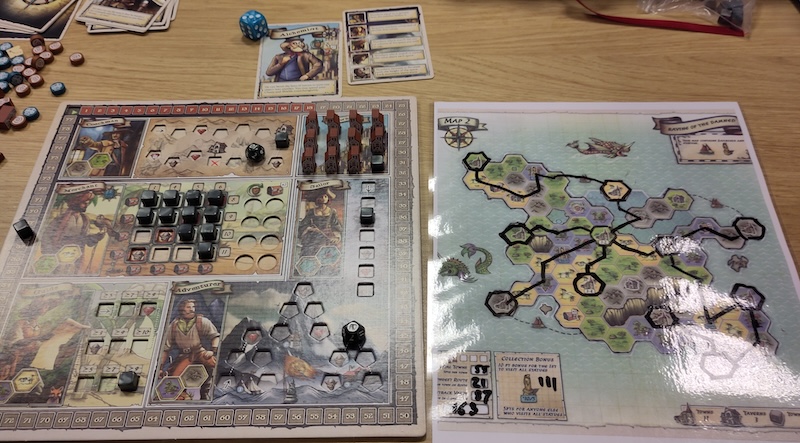
Ultimately, the aim is to visit all the towns on the map, with the first player to do this stopping the game and initiating scoring. There are items that can be collected along the way and taverns to visit which offer a choice of two cards. These cards can grant one off abilities, give the player a quest to complete or another travelling companion that only they can use. Points are gained by visiting towns and activating gems and lost by encountering goblins. It’s a fun game that instantly makes you want to try again with a different strategy. Jeremy ended up winning with James coming second. Dave on the other hand found satisfaction in teaching the game and so also counted himself as a winner!
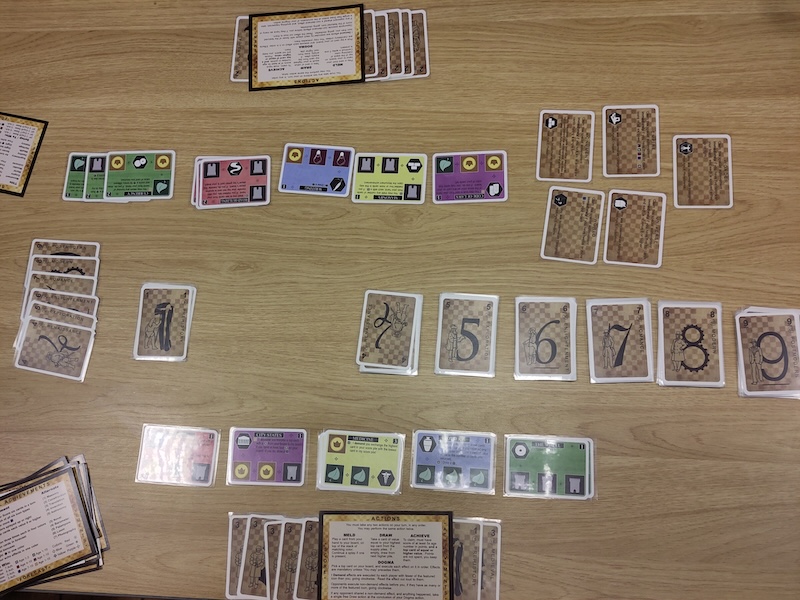
Simon and Darren finished the evening off with a 2-player game of Innovation, a tableau building game where you bring your civilisation from pre-history up to the near-future with nothing but cards. There are 10 supply piles, each representing an era, a handful of achievements and the space you will be playing cards in. At the start of the game each player takes two Era 1 cards, simultaneously playing one to start their board, whilst the other becomes their hand. Each turn you have 2 actions, taken from a choice of 4 – Draw, Meld, Dogma or Achieve. Drawing takes a card from the current Era and adds it to your hand, whilst Meld allows you to add a card from your hand to the top of your board, which will eventually have 5 different coloured piles. Dogma allows you to play the top card of one of these piles, with each card having unique effects, and is the main action driving the game. Achieve lets you take one of the achievement cards for scoring if you have met the criteria for it.
This is another of those games that has very simple rules but a lot going on, as each card is unique and there are combinations to figure out, alongside the fact that it could be possible for an opponent to ‘copy’ your move if their board has more visible symbols that relate to the action than yours. The board cards can be splayed out left or right with certain actions, which will then reveal more of the symbols allowing for other effects to take place and allowing you more opportunities to copy another player – although you actually get to copy their move before they do.
It was a fun game with Simon taking an early lead from achievements – each achievement needs you to have a certain score and be in a certain age to claim, so as one goes the next one needs you to score higher, so best to grab it sooner rather than let an opponent get the needed score. There was some interesting swapping of scores as certain cards let you take scoring cards from another player, and a few fun runs where Darren’s luck was letting him draw cards which scored and then allowed him to draw again, which if scored would draw again. The game ended before reaching Era 10, where there are a bunch of crazy cards with various insta-win conditions (not always in favour of the drawer) but Simon clearly won by claiming 6 achievements first.
Next session is on Wednesday March 18th 7.30pm at the St Ives Corn Exchange. Bring your favourite new games or dust off some classics or see what the rest of the club has brought. Suggest games or book a seat on a specific game on the Discord channel in the days before the session.
- Total Session Attendance: 15
-
Board Games: 6