8th January 2026
Fourteen players brought a lot of new games to the first session of 2026, working through history from the Middle Ages to the Roaring 20s with some time for animal encounters on the side.
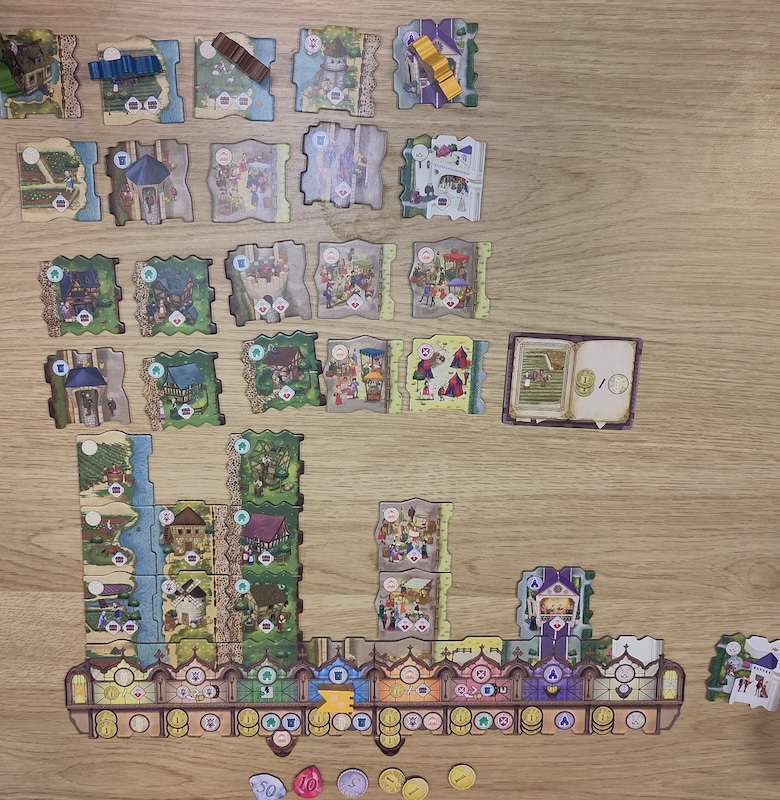
Middle Ages was the first short game on the table and first new game of the year. It shares a lot of its DNA with club favourite Kingdomino (17 plays), with a drafting phase involving building tiles with numerical values so that lower value selections give an earlier turn in the next round. Also the scoring, it is all about making money and most of that comes from multipliers on how many of certain building types you have in your fiefdom. For example, windmills have a base multiplier of 2 coins so when you have 4 windmills you will score 8 coins that round. But is is possible to add to that multiplier through bonuses from the special actions when building churches and palaces. The game plays over 16 rounds with an event every 4th round, sometimes good such as bonuses for certain icons or sometimes bad like the plague. There is a little interaction between players in the drafting phase with the windmill and barracks buildings that compare fiefdoms and cause 2 coin taxes or destruction of a building. Easy to teach, particularly for those familiar with Kingdomino, and a nice drafting game that takes around 30mins to play but does need a lot of table space for all the tiles.
The next table tried Tsuro on its 6th play at club a simple lay a tile and move through a maze type survival game. Then the table moved on to Spots a dice collection and risk taking game on its 5th club play.
The final table of shorter games did Roaring 20s and Heckmeck.
As a quick starter 6 sat down to play Heckmeck the German box for Pickomino. This is a dice-rolling push-your-luck game similar to Yahtzee but with the addition of some worms, as it’s very loosely themed around chickens pecking at worms? Dice are rolled, any one matching value is chosen to be put aside and the rest are re-rolled. Already chosen values can’t be re-used and the final set has to contain at least one worm (printed on one side of the dice), with the score aiming to match one of several tiles that are used for scoring. If your total is lower than any of the tiles, you save no worms, or roll and find you cannot use any of the dice then you are bust, and one score tile is flipped, acting as a game timer. Player’s scoring tiles are stacked in a pile and if someone else scores the same as your top tile they can steal it (much to Steve’s disgust). Several handfuls of dice later, with only some mild cursing and a spot of petty larceny, Rich, Steve, Steph, Darren and Jyo all failed to score as well as Dave B unfortunately.
This was the first outing at the club for Roaring 20s, which is a small card game, published by Pegasus Spiele in 2024. There isn’t really any theme, but this is made up for by the wordplay in the title. The art depicts dinosaurs in the 1920s (with a Great Gatsby vibe) and dinosaurs presumably used to roar! Game play is similar to “For Sale” with a central auctioning mechanic, but is not as clean, with a few extra fiddly bits to navigate. Each round, players bid for a dinosaur card, using food / diamond cards in their hand. Certain dinosaurs prefer certain foods (naturally) but all can be won over by diamonds. If you win the bid, you get the dinosaur. If you drop out of the bidding you claim one of the face-up food cards (replenished each turn), so that you have a better shot of winning a dinosaur in subsequent rounds. Thus, the choice is to go all out for a particular dinosaur or strengthen your bidding hand. No additional bidding cards are given to players throughout the game (after a starting hand of four cards); they all need to be claimed, so you need to choose carefully when to bid and when to claim. But why do you want dinosaurs? This part of the game is about collecting sets, as dinosaurs have a numerical value. You get points at the end of the game for pairs, triples or runs, plus each dinosaur has a number of stars on it that also contribute to scoring.
Graham, Richie, Neil and Dave set out to coax dinosaurs into their hands and after a relatively short period, Dave (owner of the game) emerged with the most points. It is a game that probably requires a few repeat plays to get into the swing of, so he is not letting the victory go to his head.
Then it was time to reshuffle the tables a bit and get out the longer games.
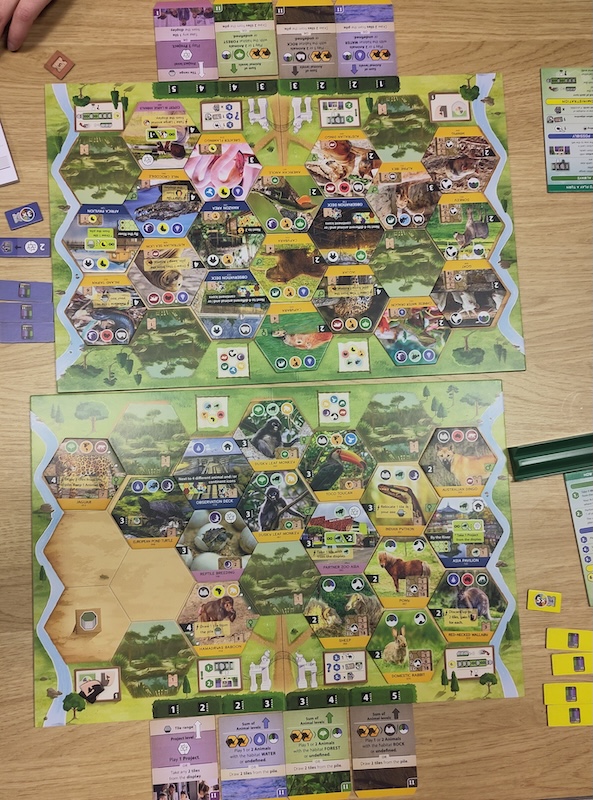
The first table tried a new standalone game Sanctuary based on the Ark Nova franchise, which has had 7 plays at club. This variant is a tile based one, where players have 21 spaces to place down attractions in their zoo; animals, buildings or projects. As in the original there is a sliding action mechanism to determine which tiles you can choose from and when you can play them down, with larger animals requiring the matching enclosure terrain type action to be more powered up. This version plays a bit quicker than the original, with 3 experienced Ark Nova gamers it took around 1.5hrs to reach one full zoo and a zoo with all 4 conservation projects achieved triggering the final turn. This caught the last zoo out with one turn short of achieving their zoo filling move, so the game was quite well balanced for ending at the same time for all. There are a lot of ways to score points, with critical decisions on tile placements to allow contiguous runs of animal or geographical icons or adjacency dependencies like being on the edge of the board or having space to expand enclosures for large animals. Thematically it worked very well, the iconography is quite simple and it was really easy to play with a little Ark Nova experience. Jeremy won by a reasonable margin with conservation scores tipping the first and second places so acquiring tiles matching those 5 objectives helps, but this could be overcome with a strategy using the other animal or geographical icons if there was some synergy in the placed animal and building tiles. As usual a satisfying puzzly game win or lose.
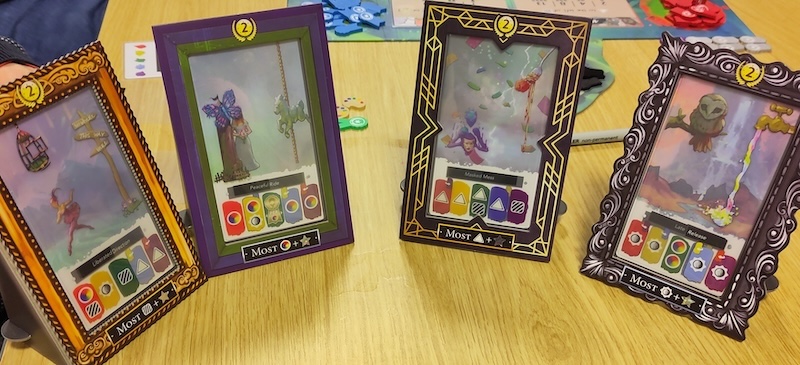
Canvas has been played three times previously at club, first in session 76 but this time included some of the expansions. This is a very pretty peaceful card based game themed around a painting competition, where semi-transparent layers of cards are built up to generate different pictures. The expansions add reversible cards. Different combinations of layers build up icons that determine the scoring.
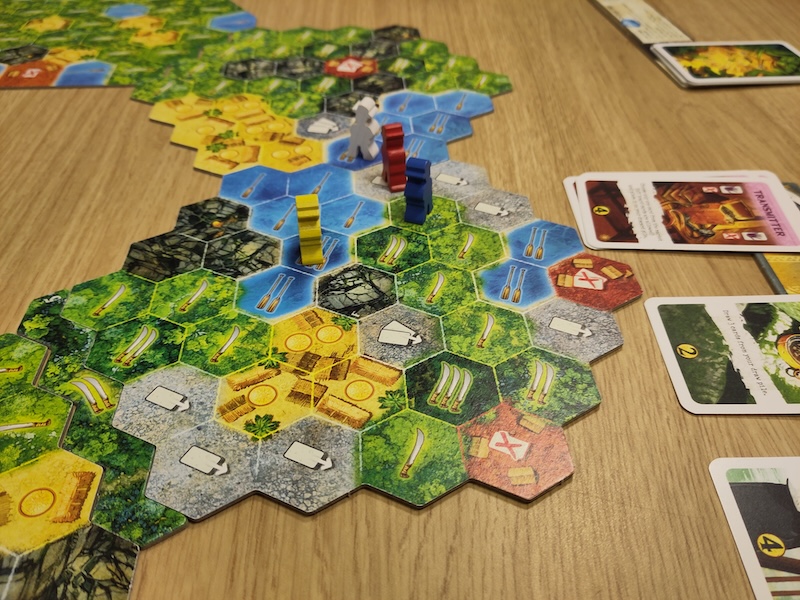
The Quest for El Dorado, was back for a second play at long last, since the first time in session 25. This a race where your expedition leader chooses a route through hexagons filled with jungle, villages, rivers, rubble and base camps to reach El Dorado. In addition, there are mountains that totally block any traversal. To travel, you use your hand of 4 cards depicting what terrain you can navigate through. To travel faster, you may purchase higher value cards, which also allow you to go through shorter routes, or other special cards. To go through a base camp, you remove from the game 1-3 card(s) in your hand - which can be useful to remove lower value cards and make the higher value cards turn up more often. There are also interesting choices of route - do you wait for a high value card to use a short cut, or do you go round? Which card type do you need most? Which card type is likely to come next in your hand? Also, you cannot move on or through a hexagon occupied by another player’s expedition leader. The game uses various boards that can be combined in different ways to make the game different each time. Graham won the first game, by 1 square, blocking his competitor. Buoyed by this success, we played again, where Neil won by 1 turn, and Graham who was a distant last, managed something more respectable by a last-turn surge.
King Arthur was once again regretting some of his choices as he sent his ‘best’ grail knights out to seek eternal glory in Tales of the Arthurian Knights, last played in session 109. Steve and Darren ventured forth once again as the lovelorn Baby P (Sir Percival) and Sir Palomides, with Jyo this time taking Sir Galahad. Early quests saw Baby P heading to Brittany to deal with some fallout related to Arthur’s brother Sir Kay, Galahad heading North and proving himself to not be as pure as all the stories make out, and Palomides making his way to Dublin, only to be sidetracked and going to Brittany, presumably hoping to sort out whatever mess Percival had left.
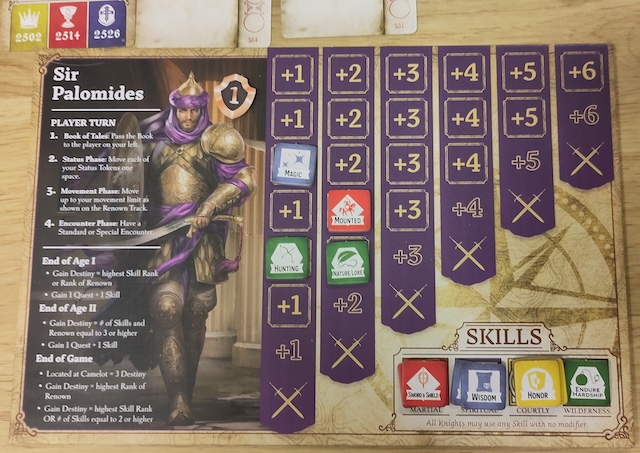
Early encounters may not have been exactly what Arthur was hoping for, with Percival worried about marrying a prince but ending up marrying a minor princess, Galahad getting turned into a deer after several attempts at amorous liaisons with various damsels in distress, and Palomides spending some time as a lemur. As we moved from the age of tournaments to the grail quest everyone got dealt a quest which allowed the other players to helpfully place the quest markers on the board, somewhat obviously all getting placed in faraway locations, requiring the knights to traverse the kingdoms. Which caused much whining from Baby P as Merlin popped up to send him to a variety of other locations on his way, coconut shells in hand. By this time Galahad had also gotten married, had shaken off several pursuers (mostly caused in some way by amorous ambitions), become both covetous and licentious, and was on the brink of becoming a polygamist. Palomides was spending his time doing extensive research for all his tasks, much to the disgust of Percival, never one for reading.
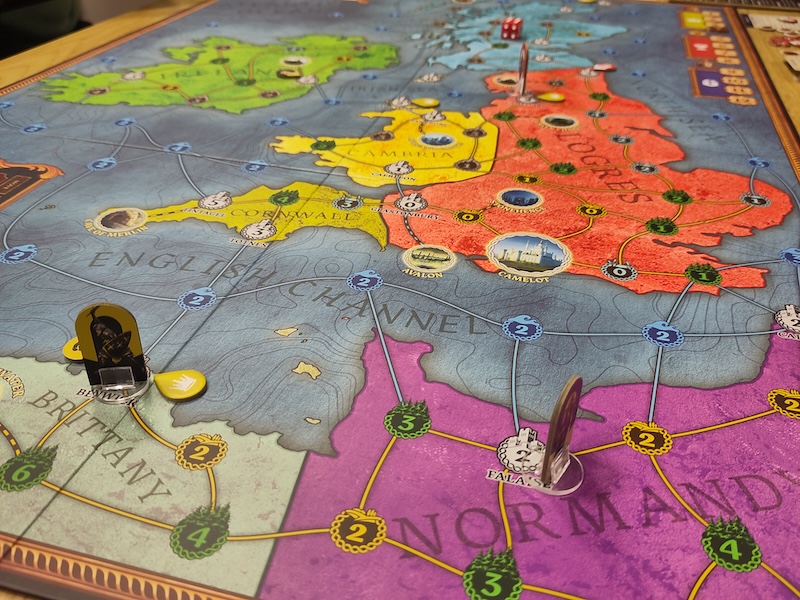
The final age was fast approaching it’s end, but the end of the night was approaching even faster, so eventually the game was called on the penultimate turn, with Galahad having gained the most Destiny by far through his very impure actions, and all Palomides’ learning leaving him almost forgotten in the history books, with Baby P somewhere in the middle, married but still pining for his lost love Muriel. And King Arthur likely shaking his head in despair that these were his famed Knights That Say… Knights of the Round Table.
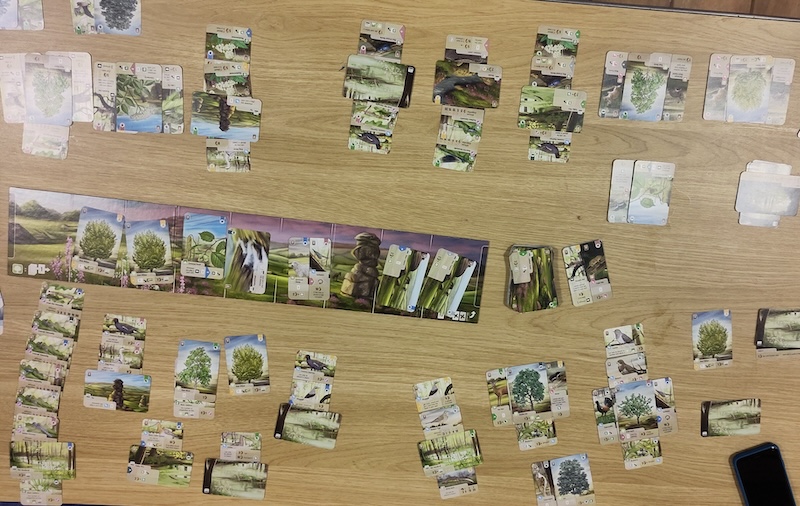
Then as 2 tables had finished there was another reshuffle and a 5 player game of another new version of a club favourite Forest Shuffle Dartmoor was tested out. This standalone version adds moors to the tree and shrub cards that can host your smaller plants and animals. Some animals, like the heron, can only be added to a moor and moors only use the top/bottom type cards but you can slide 2 of each type under the moor card. The gameplay is fairly similar but with different thematic animals, dragonflies rather than butterflies, more birds and rodents. The challenge is finding cards that work synergistically together, and being able to sacrifice enough other cards (they are all so tempting to include) to get them out before winter comes. In this game James went heavy on the bat strategy again, which did net more than 60 points from bat cards but this poorly balanced ecosystem was just beaten into third place by 3 points by joint first winners that had used a bird / fern and blue leaf icon strategy with a side helping of bats and a dragonfly / bird moorland strategy.
Next session is on Wednesday January 21st 7.30pm at the St Ives Corn Exchange. Join in on the night and bring games then play games, or request games and book seats in advance of the session on Discord.
- Total Session Attendance: 14
-
Board Games: 10