29th April 2026
The Vikings were back this week, sharing table space with cave loving dragons, underwater city building and space conflict.
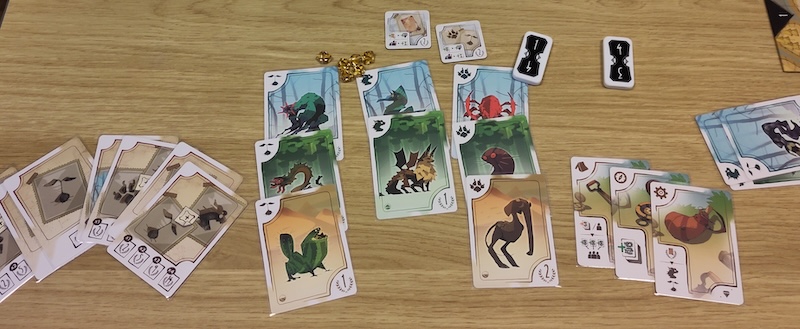
Vivarium returned from session 123, the theme is about Victorian era explorers documenting creatures in a newly discovered massive cavern. Really a set collecting game with the twist on how you acquire the cards being a grid with dominos determining the grid coordinates. Jeremy grabbed a lot of extra contract cards, Graham liked collecting gadgets, Iker collected a lot of plant type creatures, but Kathy just won with a rounded strategy, some high scoring creatures, winning a few round bonuses and three well scoring contracts.
First up, Dave, James and Reynaldo played Cat in the Box, an initially confusing game of “quantum trick-taking” where cards don’t have a suit until they are played. All had played the game before so this session was about strategy rather than getting to grips with quantum mechanics (James has a degree in Physics so had a considerable advantage!) Three rounds were played and unfortunately each one ended with a paradox which means that someone was left with cards in their hand that can’t be played according to the laws of physics (or the game). Reynaldo and James tied with 10 points each and Dave, having caused two paradoxes had a pathetic -2 points.
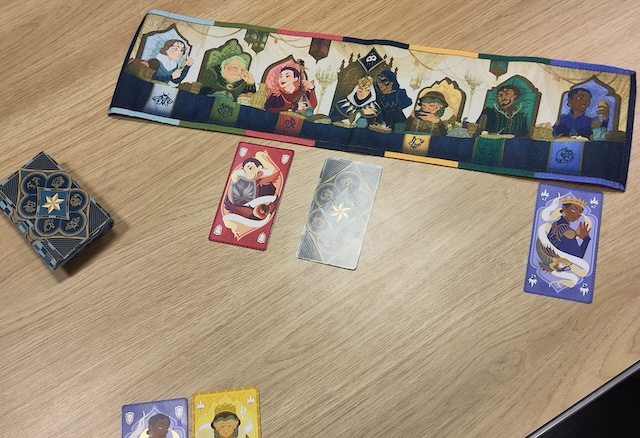
Second was another short game “Courtisans”“ where players play three cards each turn, one in front of themselves, one in front of someone else and one to the centre board, which determines which houses score points and which ones lose points. Reynaldo, James, Richie and Dave played this one with Richie proving most adept at navigating the social pitfalls of high society. James came a close second and clearly Dave and Reynaldo need to work on their social skills!
Four feisty Vikings feasted vigorously for Valhalla in A Feast For Odin: The Norwegians. Yes, more Viking based gaming and more from Uwe Rosenberg, with this being its first appearance at the club, after several re-scheduled attempts. The Norwegians is an expansion for A Feast For Odin, but one of those that replaces a lot of the original and becomes a standard for many, in a similar manner to something like Tuscany. It streamlines some of the game, changes a few other bits to better enable certain strategies and adds some more actions and areas. The game can look a bit intimidating at first sight, it’s a worker placement game at heart with around 60 places to use, and player boards have 90-odd spaces to cover using tiles gained in the game. Not recommended for the AP-prone gamers out there.
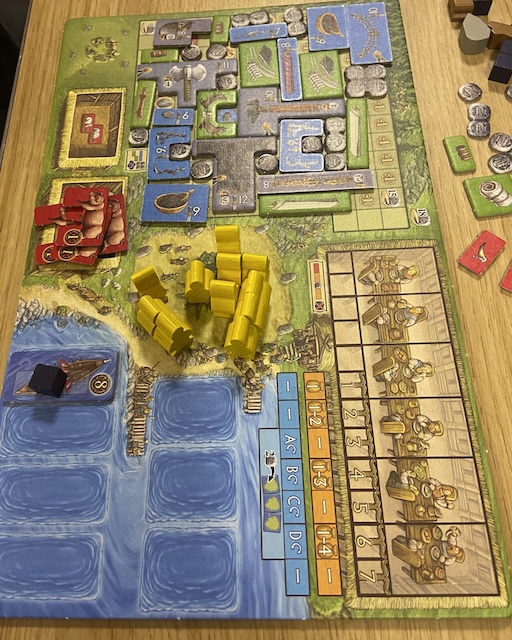
Each player has 12 Vikings, 7 of which start at the banquet table and act as the game timer. At the beginning of each round a Viking leaves the banquet hall and joins the other Vikings in taking actions, at the same time leaving more space in the hall that needs to be filled with food at the end of the round. There are far too many actions to cover in a short(ish) write-up, but they mainly centre around gaining food for the feasts, gaining items to cover up the player board, gaining resources to help gain items, gaining boats to help with raiding, whaling, pillaging or emigration … basically a lot of gaining to be done. Why might you want to cover your player boards I hear you ask? Good question dear reader. The player board controls your income and bonuses gained at the end of the round. See … more gains to be had. A diagonal line runs through the player board and the bottom-most visible space in this line shows the income. But to cover a square, you have to cover all the squares to the left and below that one. And there are rules as to what you can place on this board and how. You didn’t think you’d be getting income that easily did you? There are also bonus squares which need to be completely surrounded to activate, and there are a variety of shapes to the tiles you’re gaining to place on this board. A large number of squares on this board also contain a negative 1 symbol - if any of these are uncovered at the end of the game, they are worth - you guessed it, -1 points. The path to Valhalla is not an easy one.
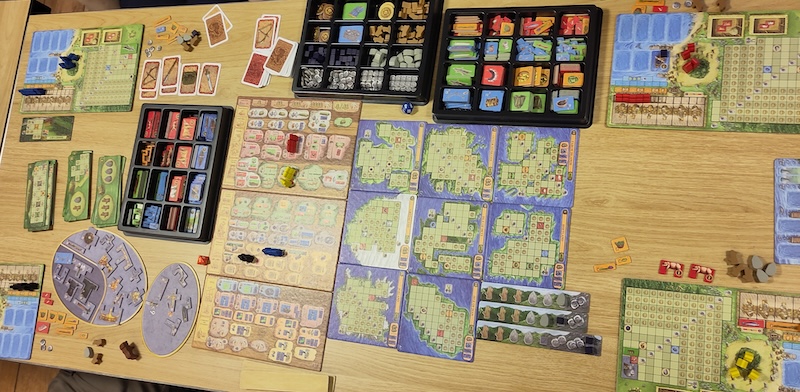
The main board is divided into areas broadly describing the actions you can take – in the Mountains you can get resources, in the hunting area you can get food, small food like some peas might be free, you could buy some fish, or you could hunt for something larger like an elk, using your weapons (spears, swords, snares and bows) and rolling a die. These areas are all split into 5 columns, with columns 1-4 dictating how many Vikings it requires to partake in that particular activity, with rewards scaling as they go. The 5th column only requires 1 or 2 (2 giving you a option of playing an occupation card for bonuses), but playing a Viking here ends the round for you. Maybe worth it if one of the other clans looks likely to be after the same thing … blocking spaces can cause an outbreak of muttering.
You can also buy a few different buildings to house resources or extra items if you think you’ll fill your board – these again grant income, bonuses and possible negative points at the end. And then there are the islands. If you’ve built a suitable ship you could go and claim Shetland, or the Faroe Islands, or Iceland, or … one of several that change as rounds progress. And once again these have additional income, bonuses and those nagging negative points for you to claim, ignore and generally mutter over.
It was down to Steph, Darren, Steve and Iain to build up their communities, go forth and conquer, and bring glory to Odin (in the form of meat and vegetables mainly). Even though it had originally been planned for some time back, not everyone had done their homework, so Steph patiently gave a brief rundown of the action areas and game flow and then the feasting began. The initial mountain tiles were quickly stripped of resources and a few hunts were attempted – not all with great success. Hunting requires a particular resource and a low roll of the D8, 0 being a success, modified by using relevant weapon cards, and Iain was particularly cursed by high rolls. Steve managed to spread his Vikings the thinnest in the first round and became proud keeper of the first player moose. At this point no-one had much in the way of items to place on their boards so income was all fairly low. Everyone managed to fill their banquet halls and all was well.
As the rounds progressed the communities grew, giving everyone more possible actions and the pests began to come out, with spaces being blocked by the larger number of Vikings available to all. Tiles began to get upgraded as everyone chased more income – each shape of tile has 4 potential sides, red and yellow are food stuffs, needed for the banquet table, with green and blue being items for the player board, with there being rules around colour adjacency and in the case of food having to rotate similar items, after all, you can’t expect to properly do honour to Odin with just five plates of peas and a single fish. Iain had managed to get himself a little whaling ship and was hunting whales to boost his food supply, albeit with more of those high rolls hampering his plans (Ishmael sends his regards). A couple of sheds had been built, and Steph had also built a long-house, boosting her income, but showing a lot of –1’s across her boards.
Soon enough Steve and Steph had both built long-ships and knarls, and were attempting some raiding and pillaging. Unfortunately, Steve was now rolling low on the D12, which required high rolls, and was facing a shortage of swords to aid him in his quest for glory. What sort of respectable raider goes out to pillage without their weapons I ask? Swords did start to become Steve’s own white whale so to speak – he spent several turns gaining weapon cards, none of which were swords. There was much muttering and indeed whining. Whiny Vikings, whatever next? Steph also used her ships to go exploring, for more income and more of those potential –1’s. Cunningly, she was also the only one to actually use some of her fleet to emigrate – the ship gets used to cover some of the banquet hall, meaning less food is required as colonists have left the community, and those ships become worth a hefty chunk of points.
Iain was struggling on with his lone whaling ship, constantly coming up against the fact it was a whaling ship and not suitable for pillaging or raiding, but still not building anything else of the floating variety. He was briefly tempting by spotting there was a Theft action space, and his little eyes lit up in joy. But then he found it was a general Theft and not directly taking from another player and so lost interest. Darren meanwhile had been concentrating on his board puzzle and was gaining a lovely case of silver every round and was watching those negative points get covered up. This meant he hadn’t built any ships though and was eschewing the traditional Viking path of raiding, pillaging and exploring so far.
As the end rounds marched ever closer Steph was making a risky choice of claiming more islands, and Darren was now seeing the benefit of maybe doing so earlier as he had filled his player board, leaving nowhere to place new shiny things. Steve had been buying many an item from the local forge, run by a seemingly cockney geezer who did have some lovely wares. Steve managed to ignore most of the sales patter and grab some items, only to realise a turn later that he should have listened as someone else bought up the anvil he’d ignored, or the lovely necklace he’d showered in disdain. Darren hurriedly built a long-house to fill with his shiny stuff, and Steph showed her experience in carefully managing to fill most of her –1’s and ignoring the not so useful spaces in her multiple boards.
When the final feasting was done, Odin looked down at his subjects and declared Steph Seierrik his favourite. By quite a margin, with 129 points. Swordless Steve came next with 88, Darren the Homebody managing 72 despite his Vikings not doing any actual viking and ignoring the whole boat thing to concentrate on the land, and Ishmael Iain coming home with 53. I’ll leave you, dear reader, to decide who it was who had not done their homework…
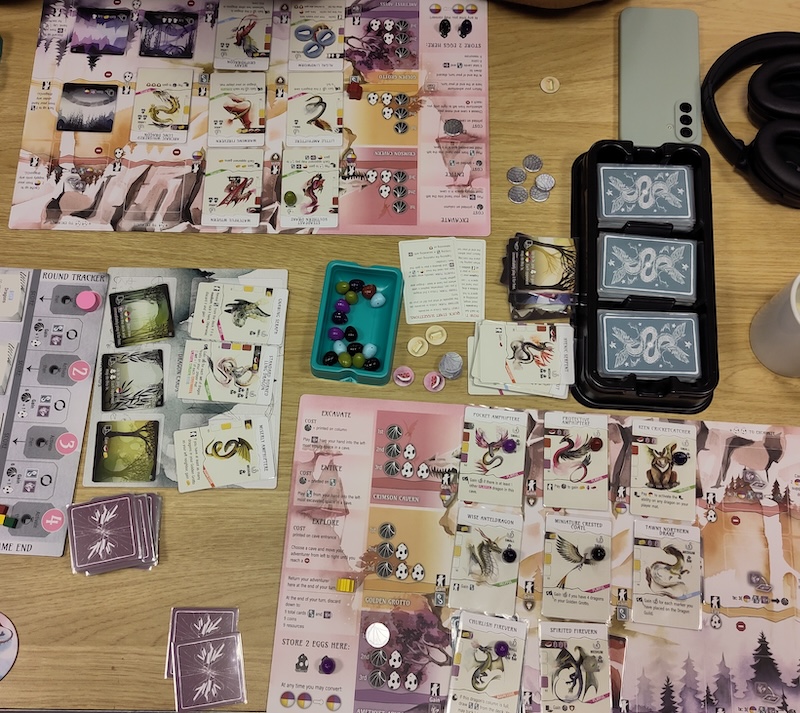
Wyrmspan was back for a fourth session, first played in Session 93. Three players were soon excavating, enticing (dragons) and exploring their caverns. No one was able to entice any shy dragons for bonuses in round one, Kathy had the most small dragons for round 2, Iker had the most excavated caves in round 3 and it was a tie on dragons with instant and end of round bonuses in round 4. Richie focused on a engine that meant he tucked 14 cards under one dragon, Kathy had some high value dragons and some with end game bonuses and it was Iker’s first game (including never playing Wingspan before either) so he was having fun learning the mechanics, filling his caves and feeding up a few hatchlings. A nice friendly game with reasonably close scores, always a popular game choice.

Underwater Cities also on its fourth play but first played back in session 23 - this time with three intrepid builders. This game is about constructing domes, tunnels, desalination plants, science labs, and kelp farms in your patch of the sea. It plays out over 3 eras, with each one having a set number of rounds, and each round gives you three actions. Actions are chosen from the board - mostly about collecting resources or building stuff, but you can also play a matching colour card from your hand (of 3 cards) to get extra resources or abilities.
James right from the start was very efficient in getting out a couple of domes with double upgraded buildings of all the types as this maximises production - which happens at the end of an era. Graham was mostly following suit, but also did some underwater exploration - we played the “New Discoveries” expansion that gives you some random bonuses for building at various places on your board. Jeremy the teacher was doing the same on discoveries but went a bit too heavy on dome construction and missed out on upgrades so was feeling a bit resource constrained on steelplast when the second era came - which also comes with a new deck of upgraded cards.
Whilst Graham and Jeremy kept on discovering, James was concentrating on his end goal of sets of building and tunnel upgrades. Graham was maximising his amount of domes - his goal - but had also improved his ability to upgrade so kept nabbing the upgrade space on the board! Jeremy was connecting lots of new surface cities thanks to special cards and discoveries, which helped his end goal - special cards - a bit, but was struggling with upgrades.
At the third era, it was getting late so we only played one round to allow everyone to get out a second goal (from those available on the board) and enable their end goal (a surface city) by connecting to it via the needed double tunnel. Graham had built the best underwater complex, with Jame’s hyper upgraded city next, and Jeremy bringing up the rear. An interesting game of worker placement and card combo, but can take a while to play all 10 rounds.
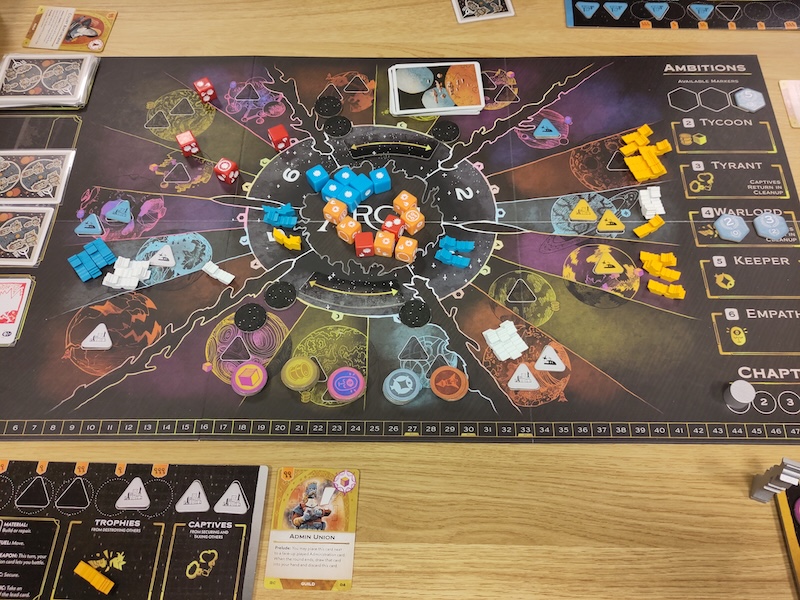
It was also Arcs time (requested a while ago but finally back on the table); last seen way back in Sessions 86 and 88. Two new players, Reynaldo and Dave, joined Simon for a journey into one of the strangest mechanic fusions out there – a trick-taking-ish space-themed euro-wargame. It was decided to follow the better part of valor is discretion, so we went base-Arcs (no Leaders&Lore).
As is common among many of Simon’s games, this one is relatively simple in terms of rules… but the implications and what to actually do is varied. Much has been said about the card play aspect of Arcs, very much a love it or hate it vibe. Across three chapters you get 6 cards per chapter and, if you don’t get any 2s then you won’t be able to declare the Tycoon ambition – even if you’ve got the best setup to win (and score) that ambition. Arcs is a game of playing with what you have, “Borrow what we don’t have, steal the rest” (for the B5 fans among us); it is a game of opportunities and denial while squeezing tiny advantages. There is long term play, realising that this chapter is not working for you so setting up for next chapter (but hoping you will get the card to declare the right ambition, and the chance to do so).
Reynaldo and Dave moved through Chapter 1, 2 and 3 becoming familiar with the game; the flow of prelude actions, actions, card play, and the all important initiative. We had to call it for time at that point (not quite long enough for chapter 4, which likely would have been the end). Simon, having played before, was a bad teacher and led at the end. Both Reynaldo and Dave were up for playing again, and perhaps even with Leaders&Lore. We had some fun moments, with Dave accidentally destroying a city in Chapter 1 to provoke outrage on Weapons and Reynaldo having the most terrible luck with one of this battle rolls (out of 4 assault dice he got two hits against Simon but took 4 hits himself; intercept it is a terrible thing).
Next session is on Wednesday May 13th 7.30pm at the St Ives Corn Exchange. Will we be going back in time or into the future, building or conquering, or all of these options? Join us before the session on Discord to suggest some games or just turn up and see what club members have brought along.
- Total Session Attendance: 14
-
Board Games: 7