4th February 2026
Ten players made it to the gaming session for a couple of long games. Unfortunately some gamers were way laid by illnesses - we hope you soon recover and get back to gaming!
One shorter game kicked off the session - a 5 person game of Seven Dragons - a strategic card game of placing dragons to make a collection of 7 adjacent that match your goals colour. Even after some goal rotating, and card zapping, a winner emerged - Dave B. with his blue dragon goal.
Then the longer games kicked off - Assyria and Vantage.
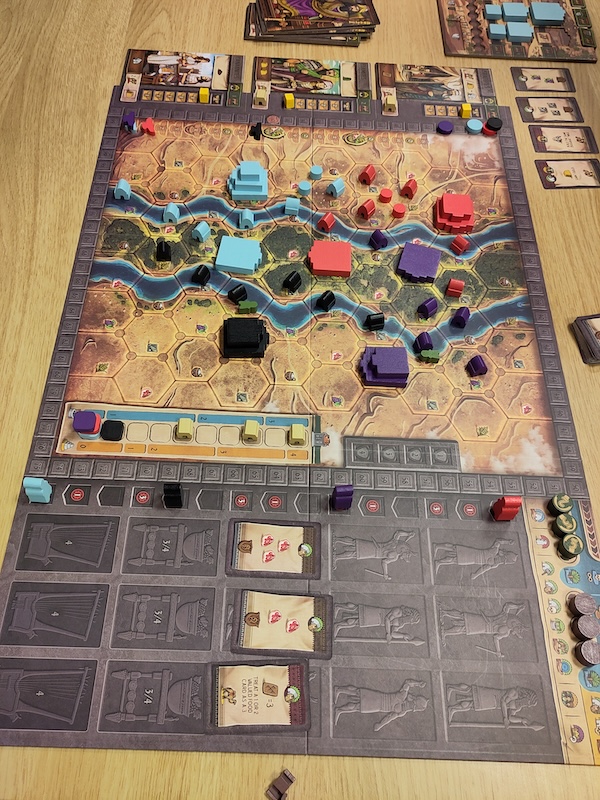
In Assyria from Garphill Games players are expanding the influence of their nomadic tribes around the Tigris and Euphrates rivers in ancient Mesopotamia. It had been suggested beforehand and Michael O. joined Steve, Steph and Darren in raising ziggurats, farming and feeding, gathering gold, facing floods and of course, collecting camels.
The game is played over 6 rounds, and each round starts with a bid for food and favour cards on a track which also determines turn order - food is required to feed your tribe, favours grant abilities to aid your expansion. After the bidding is resolved players then have to build a mandatory number of new huts (revealed by the round marker), feed all the huts, score for their placements, and then move on to the action phase. Each hex on the board has a food symbol on it which is the food required to feed a hut built on that hex. New huts need to be adjacent to existing huts, and food is often scarce enough that some careful planning is required around where you’re trying to expand as if you can’t feed a hut it is removed from the board. Huts can be built on the dryer lands outside the rivers, in the fertile land between the rivers, and even on the rivers themselves – riverside properties and early houseboats have always been popular. Huts in the fertile lands score more points than those in the drier areas. And huts in river spaces? Well, they score camels! There’s also an opportunity to build a well if you’ve built your huts in the right configuration – they can be built in the dry lands if you have a trio of huts surrounding the well space. And building a well will also gain you some lovely camels… Lovely camels, not those spitting, cantankerous ones.
Once all players have completed this expansion phase the action phase commences, and this is where the camels come into their own, as actions cost camels. Obviously. There are a variety of actions that can be taken, from swapping your camel for a hut, a farmer (helps with feeding) or a boat (helps with expanding across the rivers), to making tributes or offerings (increasing scores and abilities), to building mighty ziggurats. Some of these actions can be taken multiple times, some are tied to tiles on the player board which are flipped when taken, consequently causing a curtailing of that current camel conduct.
After three rounds a flood occurs, washing away anything on the river spaces, creating new opportunities for expansion, and resetting the tribute and offering tracks. Another flood will happen after the 6th round, after which there is an opportunity to feed any remaining huts, or watch them perish, after which comes final scoring.
The first round was fairly civilised, with no-one outbidding others for food and turn order, and there being enough food for everyone to eat. The initial expansions didn’t interfere with each other, and a couple of base layers were built on new ziggurats. Things soon changed up a bit as bidding started heating up around some of the hotly contested food cards and a few tribal leaders were bounced around the bidding track. And then new huts started encroaching on planned expansions, the occasional hut was lost to starvation, and a familiar high-pitched whining started issuing from Steve’s corner. Tributes were paid to the neighbouring Scythians to gain some points and wild food tokens, and a few over-eager plans saw some players collecting more camels than they could keep.
“Never spend your last camel” was uttered a few times, sage advice that was sometimes listened to, sometimes ignored. More ziggurats were built; existing ziggurats were built higher. Some areas were getting cramped and stern letters were sent to the local planning authorities about the neighbours unauthorised ziggurats blocking light. Planning got a little trickier as the food cards were offering scant resources, and competition was fierce for the hexes that could be fed.
And then came flood the first. Entire villages washed away, boats swept downstream and farmers lost to the waters. Once the waters had cleared a clean, shiny land presented itself, ripe for new expansions.
Outbidding each other for food was now commonplace, with many a muttered curse and lost points (bidding is done using points, paid when placed, so being outbid if you’ve already paid a point can be galling). By now each tribe had plentiful huts needing feeding, so multiple losses were becoming commonplace (Uncle Gilgamesh has gone to work on a farm far away downriver). Steph was putting roofs on ziggurats, Michael was putting foundations in Steve’s way, Steve was cultivating meat fields and Darren was having to hastily move a ziggurat as the planning officers came around and noticed it had been built illegally next to a well. There was a bit more action in the form of tributes and offerings in this half too, with it being noticed that scoring after the flood hadn’t been particularly high in these areas.
And then came flood the second. The Babylonians many cubits downstream were frankly amazed at the detritus washed past, struggling to understand who was building so much on the river. The last feeding before the flood had been somewhat poor, and many had already perished, and so there wasn’t a great need for food for the final feeding. However, there was very little to go around and the final map had scant few huts visible. But some very shiny ziggurats survived, several in a fully completed state. She-Who-Wins was once again victorious on 97, with Michael not too far behind on 85. Steve and Darren were back in the Luqaimat zone with 74 and 73 respectively.
A very fun game, offering plenty of thinky decisions based on some simple mechanisms, and looking great with Sam Phillips’ art design. Don’t get attached to your tribespeople, plan your ziggurats and never spend your last camel!
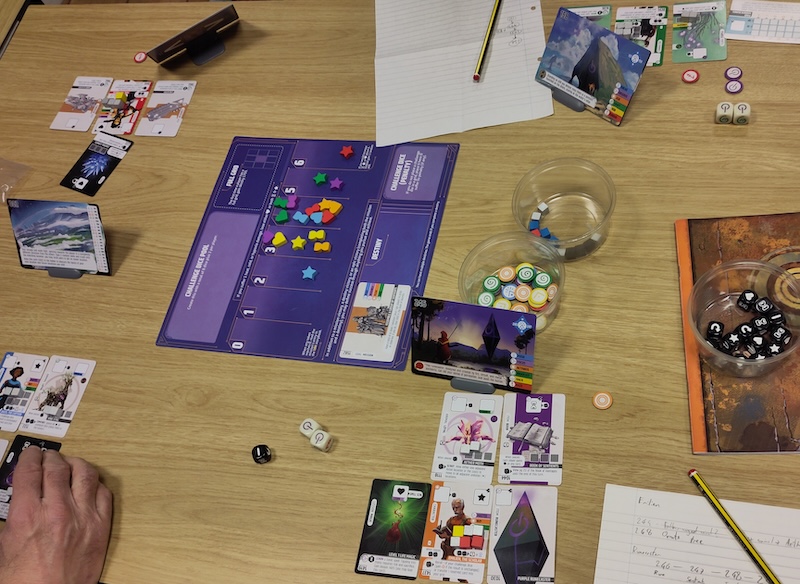
Vantage was back at the club for a second outing. It is a co-operative exploration game as you are stranded in different locations on a planet with only your communicators to keep in touch and help each other out. This time the band of six stranded spacefarers had a mission to recruit 7 sentients between them - to forge an alliance with humanity. This is how it went for each of us…
The Marine (Dave) landed in amongst some unfriendly looking crab creatures, but after offering his hand of friendship (as he had no food), they generously gave him some sand. He then went on to find part of our crashed ship, but this only yielded a circuit board. Some more searching and they stumbled on some device that gave him the power to control the weather!
Our Scholar (Elliot) managed to befriend multiple denizens of the planet - a moth and a deer - to his side, and even had a long discussion with 3 sentients about the positive side of humanity, but none of them wanted to join him. In the end he researched our goal and found that rune casters might help us to to recruit sentients!
The Navigator (Jack) stumbled on a rune caster but couldn’t quite work out how to use it to call a sentient and ended up broad casting a signal which wasn’t answered. Trying a different tactic, they accidentally decided to annoy 3 sentients hiding in chests by stealing a valuable artifact and having to run for it!
The Engineer (Jeremy) started off crashing right next to a sentient, but apart from having a very long discussion about building boats (that then get eaten by Krakens) he was happy where he was. So wandering away the engineer found a waterfall with an underground cave, my team weren’t convinced this was a great direction, but after getting past a large door, and then entering a portal to forest location, they still found no other sentients!
The Medic (Simon) was trying his best to interact with every creature that he came across, from aiding a sentient that was in need, to honouring a golden relic worshipped by bird-like people but was only showered with flowers for his efforts! Eventually he came across a sentient drawing designs in the sand, but couldn’t catch his attention!
Our Captain (Graham) landed by a chest and managed to dismantle this whilst trying to craft something from it and out dropped a tome of spells. After spending some time scouting the area for sentients and coming up short, they had built up enough energy to use the teleport spell they learnt to join the Medic. Then they tried a different tactic to recruit the Sand Sentient by helping them build a sand sailing racing vessel!
After a couple of hours adventuring (with 4 new players) we decided to call our mission somewhat complete and head off homewards. It is an enjoyable light RPG (as you have to explain where you are and what you can see and do), but it can be a tad slow to get round every ones turns, so it maybe best with four.
Join us at the next session on Wednesday February 18th at the St Ives Corn Exchange. Request games and book seats in advance of the session on Discord or just turn up.
- Total Session Attendance: 10
-
Board Games: 3