14th October 2026
Braving the screams and 8-second bursts of high volume pop and techno, 8 gamers made their way through the corridors and drapes of the Corn Exchange back rooms to engage in some game-playing, this time just 3 longer games featuring dinosaurs, fast food and ice-bound archaeology.
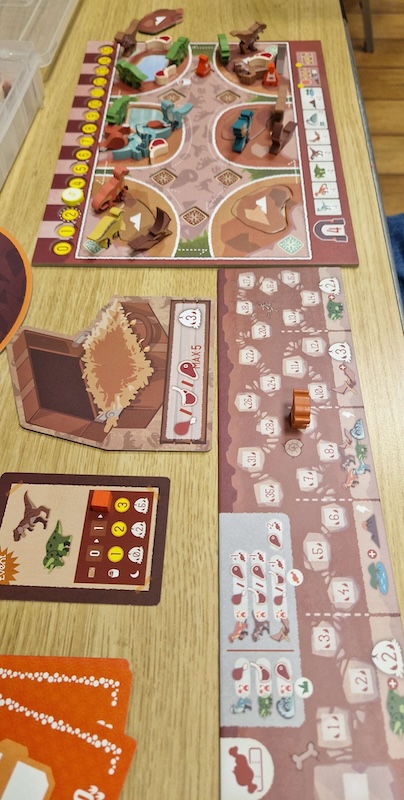
Having learnt nothing from the Jurassic Park franchise the first table decided they could run their own Dino Garden. This is a set collection game based around creating the best dinosaur park by careful placement of said dinosaurs in their habitats, or gardens if you will. Player boards have 6 gardens which to start with can hold dinosaurs up to a value of 4, a path for the keeper, and a path for the feeder. Each park can be upgraded by the addition of either a lake or volcano, which increases the size of the area to 6, with lakes giving bonuses to herbivorous dinosaurs, and volcanoes giving a bonus to carnivorous dinosaurs. The main board has a rondel on which 19 tiles are placed each round for the park owners to move around, and 4 pairs of objective tiles. On your turn you can move the owner any number of spaces along the rondel to claim the dinosaur or special action on the tile. However, it is always the turn of the player at the rear of the rondel who takes their turn, so if you jump too far ahead to claim that Pterodactyl you’ve been hankering for the other players may have several turns before it’s back to you. There’s also a wasteland area where a couple of spare dinosaurs are apparently roaming, and where you can import the volcanoes from. They’re quite easy to move apparently.
Smaller dinosaurs like Velociraptors take up 1 space in a garden, with larger Triceratops or Tyrannosaurs taking 2, and the giant Elasmosaurus taking up 3 and requiring a lake to live in. When you claim a dino, you move your keeper up to 3 spaces clockwise and can then place the new acquisition in one of the gardens to either side, possibly doing some landscaping in one of them as well, for a small fee. As they complete circuits they collect funds, which can be increased by meeting certain criteria around dinosaurs in the first 2 enclosures. If you claim a herbivore you also get some meat, small, medium or large chunks depending on the dinosaur involved. Carnivores will eat the meat, and certain spaces will allow you to move the feeder anticlockwise picking up and dropping off chunks of meat as they go, so if you have one garden full of Triceratops you can take the meat round to the T-Rex enclosure. Some of them are fussy eaters though, but they all seem to get along in a very friendly fashion, so you could plan to have your meat producer in the same enclosure as your hungry dino. Not feeding them does no harm but feeding them will move you up the predator track, with bonuses and end game scoring available. There are also special dinosaurs on offer that are so special they take up no room in a garden and provide some bonuses, normally around end game scoring based on what’s in their garden.
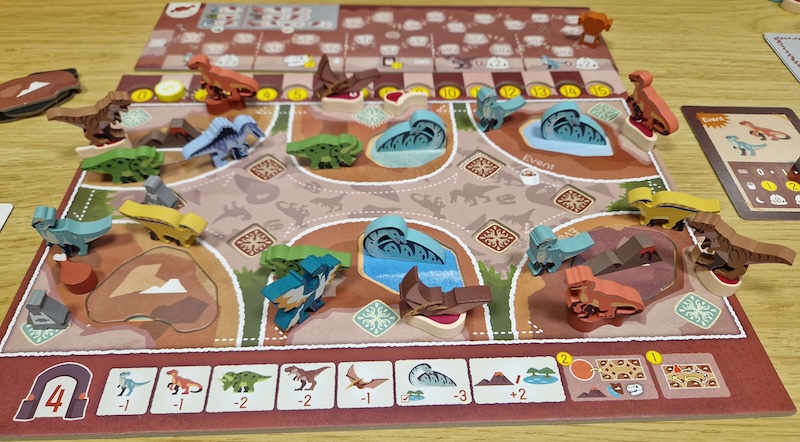
Steve, Darren and Dave were the plucky palaeontology peddlers, and were soon happily collecting no-longer-extinct giant lizards in order to entertain the masses. What could possibly go wrong? It wasn’t long before lakes had been excavated and volcanoes erected (not erupted luckily), but maybe not always in the best places. Steve and Dave were quick to get the required pairs in their early enclosures, ensuring funds were coming in, whilst Darren was getting a varied selection bedded down around the park. Certain dinos proved irresistible, leading to some big jumps around the rondel, giving those with a bit more patience a chance to collect a few more of the more ‘mediocre’ dinosaurs, as if there were such a thing. Steve looked to be shooting ahead for most of the game, with a heavy collection of velociraptors and tyrannosaurs, with enlarged gardens to hold them all. Darren had managed to grab a couple of the big lake dwellers, as well as the rare pterodactyls, which proved to be a great combination at feeding time, with the Elasmosaurus providing the biggest steak, and the Pterodactyl getting bonuses for eating the largest steak.
Coming into the third and final round Steve seemed to have it all going his way, although having such full gardens meant he got stuck a couple of times trying to fit extras in. Which is how it ended. Until the actual scoring that is. This was the only downside to a fun game – everything was laid out nicely on the boards once you knew the iconography, except for the scoring, which required checking the rule book, and luckily the BG Stats app had a score pad for the game already, as although production values were really good for the actual game, the score sheet had gone very old-school with a ‘photocopy this page for scoring’ affair. One of the things that had been missed as the boards were looked over at the start was the predator track ramped up considerably at the end of the track, with it being jumps of 1 point up until the 20’s when it certainly started taking big steps. No-one, including Darren, had noticed that his good feeding strategy was paid off with far more points than expected, and in the end it was 122 to Darren, 96 to Dave and Steve coming in last with 94 to the genuine surprise of everyone, who had all pegged him as a master dinosaur wrangler.
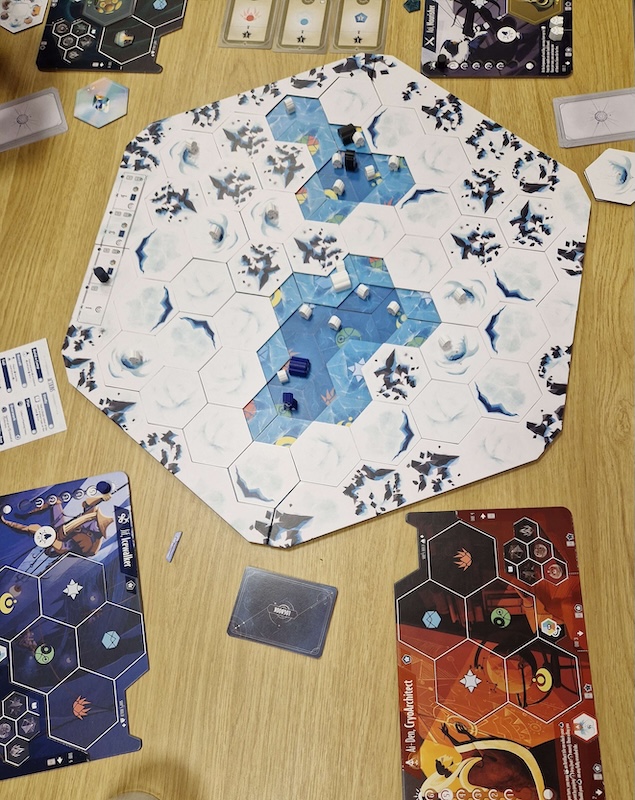
Meanwhile the second table was setting up I C E under the supervision of James, who had suggested it a few sessions ago. This is an exploration and worker placement game set on a frozen world where every year various guilds send expeditions out to a long-lost city to hunt for artifacts. It’s played on a multi-layered modular board, with players taking on the role of guild expedition leaders, moving explorers and archaeologists on the board and digging through the layers in search of artifacts to send back to The City, the last bastion of civilization on this ice-bound planet. During the planning phases guilds will set their Exploration Points and reveal the Event of the day in the log book, which will affect conditions in the Exploration Phase. This consists of using the Exploration Points to move teams around and excavate down into lower levels, by removing the tiles on the top layer, with there being 5 layers in total. As tiles are removed, any explorers on it are distributed to the revealed tiles, ready to explore and excavate once again. A number of different types of artifacts are available to be found, such as Obliteration which will remove tiles, through to Exalted which let you move Archaeologists around without expending EP’s, up to Prismatic which can act as any type. Personal and private objectives may require a guild to collect certain sets of artifacts, with the endgame being triggered by revealing the edifice at the bottom layer or reaching the last page in the log-book which has been ‘enhancing’ each day’s activities.
James, Richard and Steph donned their cold-weather furs, clambered onto their Smilodons and set off in search of ancient wisdom and treasure. Much shovelling of snow and intrepid ice climbing eventually got them to the bottom of the Valley of Elders, and the guilds were quick to count their glory. Richard had just snuck ahead with some crafty digging, gaining 45 points to Steph’s 43 and James’ 42. A close-run contest in the cold climes.
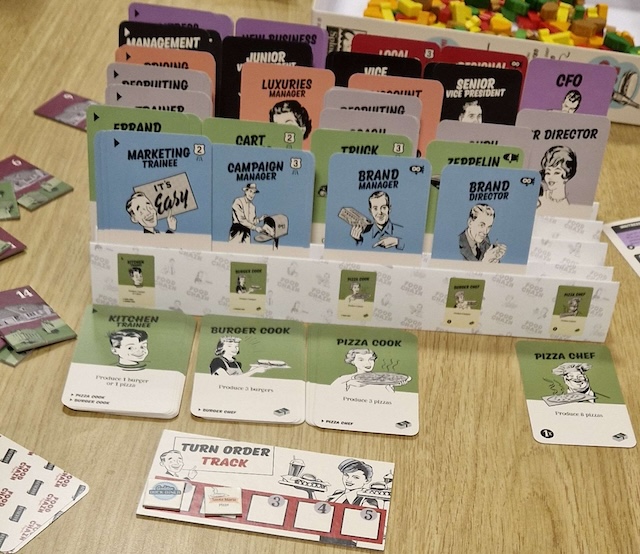
On the last table, it was shaping up to be an epic game, think Donald Byrne vs Bobby Fischer, or Björn Borg vs John McEnroe. At the last minute Simon and Iker were left to play Food Chain Magnate as a two-player game (sadly Jyo had to drop out). This is Splotter’s 1950’s themed US fast food game about marketing and selling more than your opponent(s). It’s also a playful commentary on capitalism. For those who love a bit of bling, there is a super fancy version of the game… but the basic edition is grand.
You win by having the most money the second time the bank breaks. Each round you have employees in your corporate structure, each employee lets you do something – hire new employees, train them, produce pizzas or burgers, make drinks, advertise to the masses, change prices, manage more employees, open new restaurants, or build new homes (making more demand). It’s all a delicate dance of supply and demand, trying to undercut the competition, and all the while keeping your own company moving.
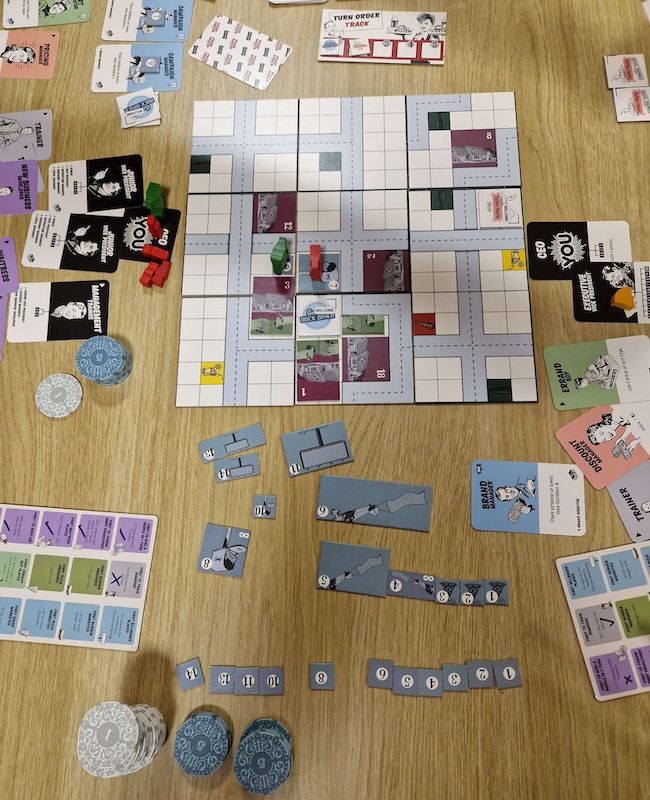
Simon has played many times before and, perhaps a tad cruelly, proceeded to demonstrate all the mistakes Iker made: mis-timing a price war, inefficient placement of a new restaurant, devastating use of foliage (adding gardens to houses makes them pay more), and showing the power of marketing.
This is a tricky game, it takes a couple of plays to see the moves and counter-moves. The margins are thin. In a two player game a mistake can mean you earn nothing in a round. Splotters are not to everyone’s taste (it’s a drink pun!). Nice to see this at the club for the first time, and it is a highly recommended game (do not play five player with new players… it will be very messy).
Next session is on Wednesday October 28th 7.30pm at the St Ives Corn Exchange. Please do contact us via Discord to arrange board game requests.
- Total Session Attendance: 8
-
Board Games: