10th June 2026
Apart from some of our usual members, we had a influx of players who had found us at the societies and clubs fair a few weeks ago. This session had three long games juggling resources, whilst another table went on a magical automobile, train and cycle ride!
The session started with a shortish game of transport links - Railroad Ink Shining Yellow Edition. This is an interesting roll’n’write game where you are using the rolled dice to draw roads and tracks to connect up your terminals on your grid. Four players had a quick base game, with Neil coming out on top by a few points ahead of Jeremy, Graham and Kathy. Last at the club in session 114 if you want to know more.
The other 3 tables got stuck into some long games - Nippon: Zaibatsu, Shackleton Base: A Journey To The Moon and one of the new boards from the Lost Ruins of Arnak Adventure Chest.
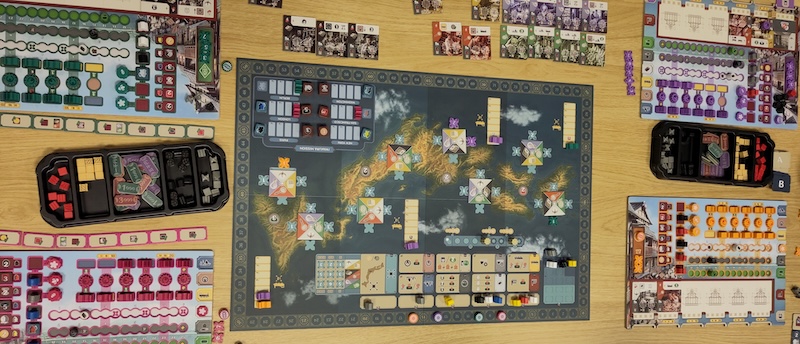
Four of us (Dave, Steph, Janek and Jyo) sat down to play Jyo’s shiny new toy from UKGE - Nippon: Zaibatsu, which is a new edition of 2015’s Nippon. Released earlier this year, Nippon Zaibatsu is an economic game where players compete as “Zaibatsu” (or large conglomerates) to grow their influence and power. The main mechanic is action selection which interestingly takes place by taking workers rather than placing workers. Each action spot has a number of randomly coloured meeples allocated to it and in order to take that action players choose one and add it to their player board. The colours do not change anything about the actions taken, but players must be careful as they pay upkeep for each different coloured meeple that they have on their board at the end of a round. This creates an interesting puzzle where players are trying to get maximum efficiency from their turns while trying to keep the fewest number of colours on their board so that they don’t end up paying a fortune in maintenance.
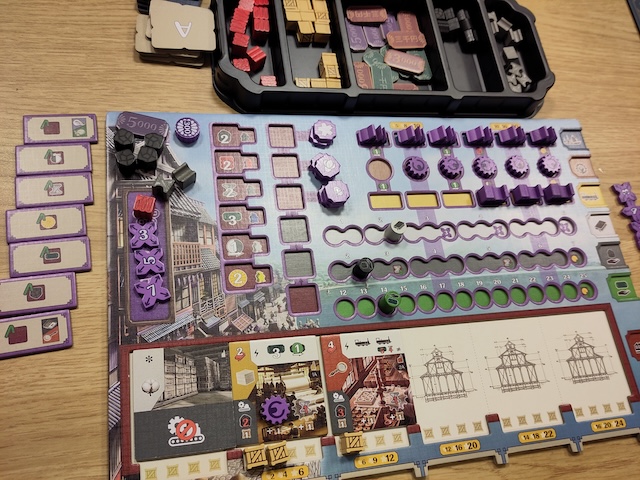
Resources are quite scarce and as with all the best worker placement / action selection type games, you never have enough resources to do all the things you want. Another interesting mechanic in the game is that players choose which conditions they will score victory points for. This means that you tend to lean heavily on a particular strategy over the course of a game and so are likely to want to play multiple times so that you can try out new strategies. Although this is a euro style economic game there is quite a lot of player interaction, as players are competing for workers of particular colours and also trying to score the majority of their points through an area majority sub-game that takes place on a map at the centre of the main board. The game feels complex at first (3.61 BGG weighting) but flows nicely and it doesn’t take long to get the hang of things.
Unfortunately for Dave, his strategy of investing heavily in ships didn’t pay off and he ended up neglecting the area majority game. Janek on the other hand optimised his actions nicely to win the game.
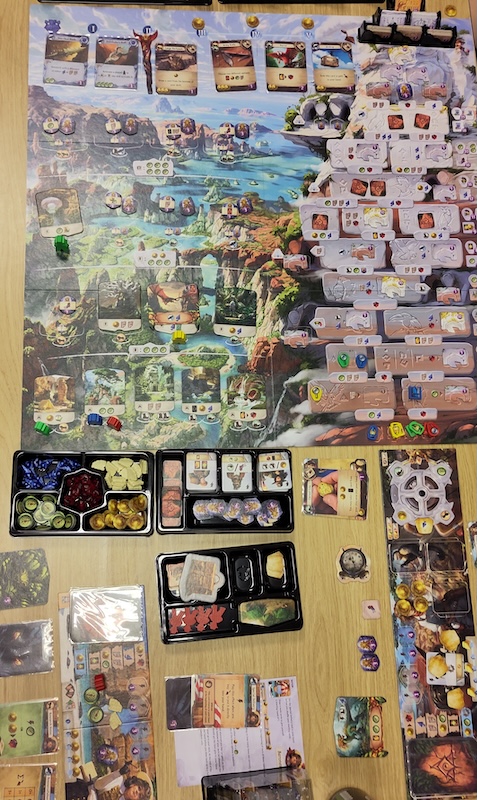
A full table of four set about exploring the lost island of Arnak with the Owl temple research board - part of the Lost Ruins of Arnak Adventure Chest. There was a range of abilities from seasoned Arnak players but new to the expansion to complete Arnak novices, so after a general teach and an explanation of the extra rules the explorations could begin. The Owl temple introduces a lantern and decisions to be made as progress is made up the research track, sideline your magnifying glass in a side tunnel early for low points but then focus on the lantern for the rest of the game, or maximise the magnifying glass but risk missing a side tunnel bonus. There are also 2-part jigsaw pieces to collect that provide slots for the icons found whilst exploring new sites that incur no penalties for using the icons and have victory points.
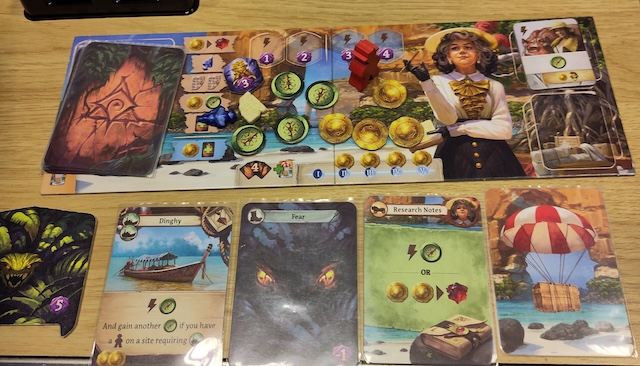
The near base camp locations were soon being explored and guardians being tamed but progress up the research track was slow. Kathy was aided by her mentor the Baroness sending regular air drops of cash and equipment, James was getting the hang of sending his falcon out to acquire resources, Tom the mechanic was learning how to use his cog wheel at the right time to gain items while Captain Will had an extra explorer to go out acquiring resources.
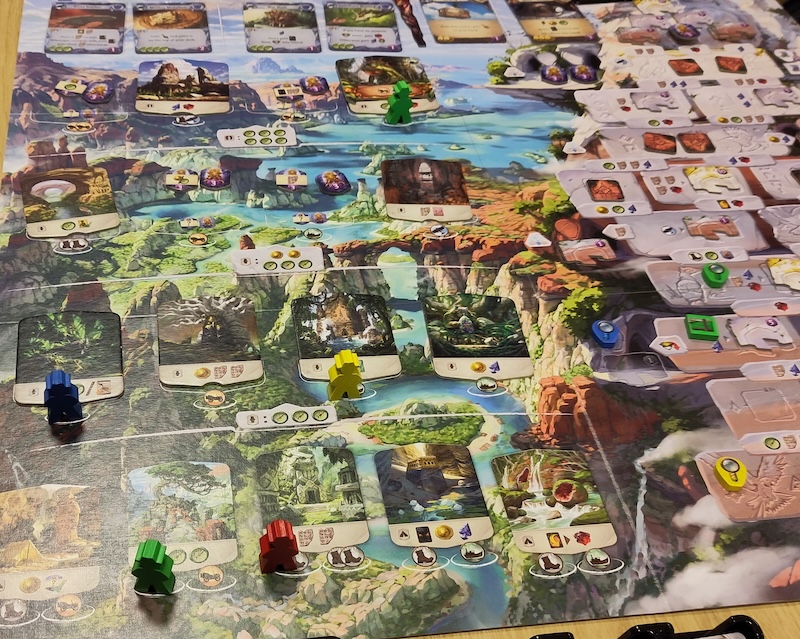
As usual the pace accelerates in the last few rounds and there was a surge in research and the last few unexplored sites were claimed. In the final reckoning it was the two that had done best at research and made it to the top of the track or close with their magnifying glass that topped the score table, with Tom just beating James, but the others were not far behind and it had been a good evenings gaming with people keen for a rematch.
At the same time, on a nearby table a moon-base is finally taking shape at the lunar South Pole in Shackleton Base: A Journey To The Moon, construction having last been attempted back in Session 94. This is a worker placement game involving various people in spacesuits doing various things on the surface of the moon and definitely staying well away from any anomalies involving monoliths 3000km to the North in Tycho Crater. Four space agencies have come together to build the base, with some help from a number of corporations who are eager to please their shareholders with lunar based profits.
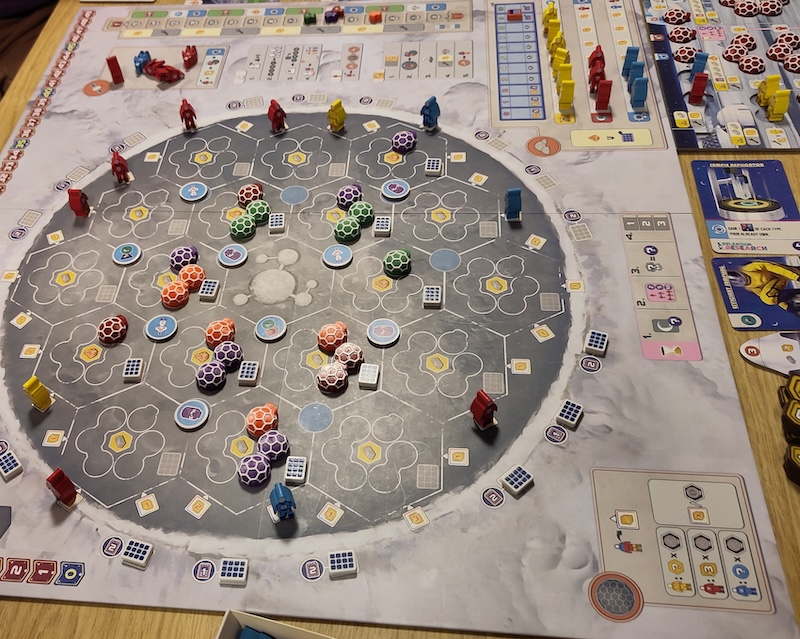
Over the course of three rounds, shuttles will deposit new workers to the moon, who will then build new domes, grab lunar resources or do the bidding of their corporate overlords. Workers come in three flavours, lemon-sherbet, strawberry and blueberry, although they tend to prefer being called engineers, technicians and scientists. Whilst out and about on the lunar surface they can each exploit different facets of the regolith – engineers can pull out resources, technicians can gain credits and scientists can interact with corporate tokens. Working on the surface involves placing a worker at a point near the rim of the crater and activating any inhabited sectors in a line.
Back at the command centre there are options for building more structures, completing projects for the corporations, or taking corporate actions. Any worker can do any action, but using the right one can grant extra bonuses - engineers are good at building, technicians are good at completing projects and scientists are good at being corporate shills. There’s also the possibility of heading to the lunar gateway station to swap out one worker for another, who can go and work inside one of the structures that player has built – domes, workshops, labs and HQs.
At the end of the round the surface workers are allocated to players based on an area control mechanism around built structures, income is generated using these workers, maintenance fees are paid for any structures that have been built and everyone looks forward to the next wave of shuttles bringing new victims, sorry, new happy workers, to the moon. The base game comes with 7 corporations of which 3 are used in a game – they vary from Helium-3 miners to tourist companies to corporations using the moon as a base camp for Martian exploration, and all come with a variety of projects, resources and actions, all adding to the replayability.
The game had been planned in advance with new-comers Sarah and Mike having expressed an interest, and they brought along Tony to join the lunar shenanigans, with Darren guiding them through the Journey To The Moon – a strange sub-title as all the journeying takes place off-game. During set-up there was plenty of discussion about the accuracy of the crater map and Shackleton crater itself – Shackleton is an actual crater at the South Pole that has been a favoured spot for ideas on lunar exploration due to being a stable temperature within the crater and holding the possibility of frozen water whilst the rim is in almost perpetual sunlight allowing for solar power.
The teach itself was relatively painless – there’s a lot of moving parts that make sense once the game is under way – but with Mike attempting to build a dome on the first move of the game it became clear that Darren had forgotten one aspect of the set-up where each player places a dome and a power source, thus enabling new structures to be built. That was quickly remedied, and then building could commence. Early moves were understandably all a bit tentative as mechanisms, and the crater, were explored. Those early moves did set up a few paths to take though, with Mike having grabbed a Lunar Hotel from Artemis Tours, and Tony stockpiling a bunch of isotopes that were of interest to Selenium Research. Sarah was also dealing with Artemis Tours, setting up a rover trail and hosting a good number of tourists (or astronauts as Darren repeatedly struggled to not call them – blaming the A on their spacesuits for the constant pausing). A few domes got built, but the focus seemed to be on Corporations and crater exploitation, with energy levels remaining high – energy being a shared resource required for certain constructions and projects, partially controlled by solar panels built by all players. The consequences of not having added much infrastructure to the base was that no one had much space on their boards to put workers for income gains. On the other hand, maintenance costs were also quite low.
The second wave of shuttles arrived, bringing new workers and resources to the slowly growing base. Five shuttles arrive, each holding a different combination of 6 workers and some resources, with players choosing their shuttle in reverse turn order – each shuttle is numbered to signify that round’s player order. The shuttle that got ignored then drops its cargo of astronauts off in the lunar gateway, where they sit around ringing up exorbitant roaming data charges whilst waiting to see if they may get hired later on. By now Tony had definitely gone down the scientist route, supplying Selenium Research with many strange isotopes he’d found ‘jut laying around’ whilst wandering about on the crater floor and completing various totally harmless experiments for them. Sarah and Mike had both invested heavily in tourism infrastructure, Mike adding a casino to his hotel complex to ensure funds stayed on the moon, or more accurately, in his pocket. Darren was doing the odd bit of mining and sending Helium-3 back to Earth, but also dabbling with tourism. Dabbling being the best description of it anyway.
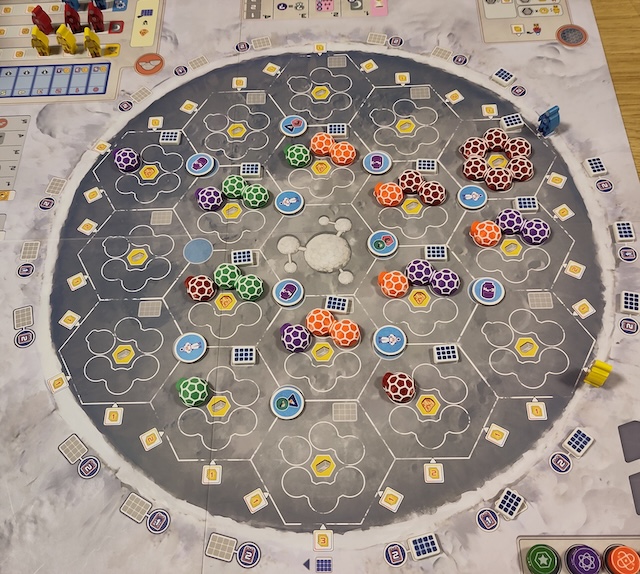
The final shuttles came in to drop off their precious cargoes, along with a quick reminder of what would actually gain points at the end, and what would not. Money for instance doesn’t score, unless you’re a dodgy casino boss and have built that casino complex. There was a bit of a shift in the last round as a few more structures got built, although it was tough finding the required resources for the right builds. Laboratories were the sought-after prize here as filling them with specific workers could gain some nice shiny points. Tony decided going for projects and experiments was the right path, more structures seemed like more work than was worthwhile. Mike and Sarah were both trying to get more projects done for Artemis Tours to get some more points from the Astronauts…tourists…astro-tourists. Darren seemed to have set his helmet visor to opaque and was wandering in circles looking for some rare earth to build his labs.
As everyone returned to the command centre to relax and watch the Earthset, points (and certain monies) were tallied up to see who had done the most for the growing moonbase. Mike and Sarah had both reached 95 with their tourist-based ploys, drawing for victory (we forgot to check the tie-break, which would have been most reputation), with Tony’s ‘experiments’ netting him 75, and Darren coming in as Lunar Loser at 51. The game was greatly enjoyed with Mike and Sarah aiming to get themselves a copy soon.
Whilst these epic games were playing out, Res Arcana was chosen for another play, this time with the Lux et Tenebrae expansion that adds in demons and scrolls as well as a smattering of new artifacts, mages and places.
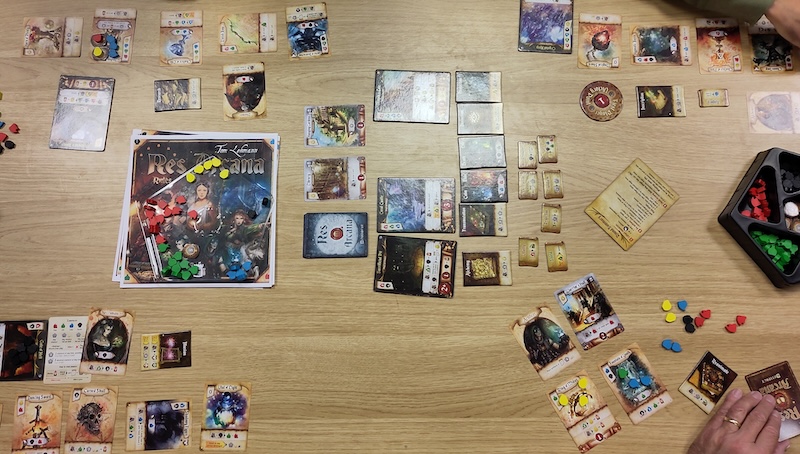
Four mages - Iain and Jeremy who had played before, taking on roles of Artificer and Necromancer respectively, and Neil and Graham who hadn’t played before, playing Alchemist and Diviner. The game is about duelling wizards who must create a magical engine from the 8 artifacts you are dealt to enable you to create the resources needed to take over one (or more) places of power to then generate victory points before your rival mages and win the match.
It starts off relatively slowly as you have limited resources at your call, but there is always a way to get out some artifacts to help start accumulating materials. Graham and Iain started collecting a smattering of all the resources, where as Neil and Jeremy went down a darker path collecting mostly death and fire. Jeremy’s Necromancer was first to afford (just) a place of power - getting the Hell’s gate - pipping Neil to it. Next Graham’s Diviner snagged the Alchemist’s Tower, but soon after Neil had changed tack to allow him to take over a Crystal Keep. Unfortunately, though Iain’s Artificer had bought a nice Warrior’s Hall, he was rather annoyed by all the places going that he had eyed up.
The Necromancer (Jeremy) busily used fire and demons (sometimes illusionary ones) to power up the Gate of Hell (of course!). Neil’s Alchemist was trying to enable more artifacts from his deck to power up the Crystal Keep. The Diviner (Graham) decided to play his luck on the Wind-up man, which can generate a lot of resources if you leave them on long enough, in order to get the materials needed to power up his Tower. Iain’s Artificer finally bought the Coral Castle, but this can’t be powered up so he then concentrated on using his Ring of Midas to create gold to buy up more monuments (each worth 1 or 2 victory points).
It was all looking reasonably close until Jeremy scraped up enough gold to buy a monument and then got very lucky and drew the Pyramids - the only monument worth 3 victory points (as it doesn’t do anything else). This pretty much scuppered everyone else’s chances as Graham had pushed his luck - keeping his resources on his Wind-up man so couldn’t access them, Neil didn’t have any chance to draw and play more artifacts, and Iain had just run out of gold buying a monument just before Jeremy (only worth one point though!). Iain decided there was no point continuing and used his Coral Castles power to “Check victory points now” (rather than once everyone had passed for a round) and Jeremy was declared supreme mage (for now)!
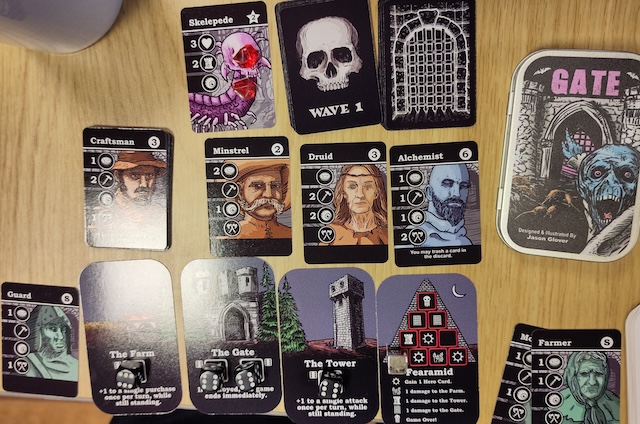
Simon turned up halfway through Res Arcana, so he challenged himself to a quick game of Gate whilst he was waiting for the mages to finish. Gate is part of the Tin Series of small solo games made as print on demand by The Game Crafter and designed by various people. Solo games are an interesting niche, even among board gamers, as many find them counter to the social aspect of gaming or diminished without the joy of playing against other humans (rather than playing computer games against bots/AI players). The rise of digital implementations of games, many coming with bot/AI players, has brought a different type of solo gamer to the table… or strictly to the screen; and several members of the club are known to play digital versions solo. Obviously we don’t see many solo games on club nights, so something a bit different.
With regard to Gate itself, it’s a small tower defence style game with a deck-builder mechanic at it’s core. You have a starting hand of three cards and can buy new cards, which are villagers, to add to your deck. Each villager helps to fight, calm, or repair. The monsters attacking your village destroy the buildings and terrorise the villagers; if the fear becomes too much or the buildings burn you lose. Victory is measured as a ‘beat your own score’ based on the victory points for all the monsters you destroy.
It is worth mentioning that solo games have a sort of grouping based on how you define winning. The narrative/story style games have victory as a reflection of how the game played out. Beat your own score games try to mimic the multiplayer feel, you want to work to improve your score as a measure of victory. Many co-operative games, like Pandemic or Spirit Island for example, can easily be played solo. There are a large number of war gamers who play so-called ‘two handed’, playing both sides; this is a whole sub-culture of board gaming with people leaving games on the table of weeks (or even months).
Unfortunately Simon’s villagers didn’t do very well against the denizens of the Gate this time around, having a few hands with no fighters (due to some poor card buying decisions and a “bad” shuffle) meant the village gate fell.
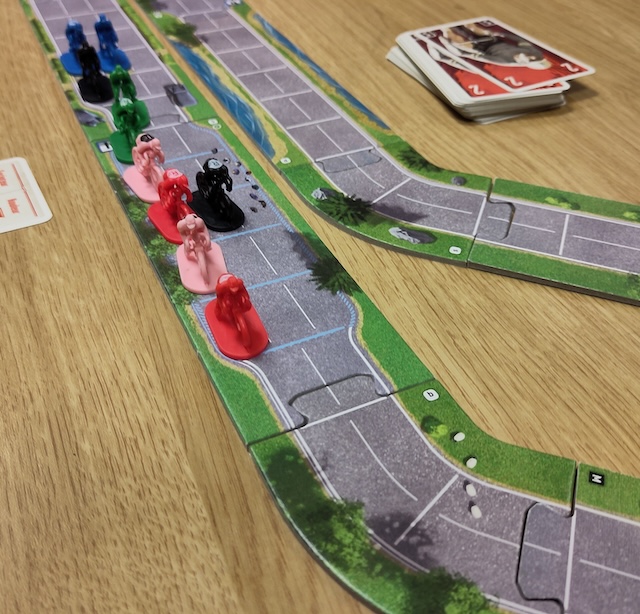
Controversial opinion, Flamme Rouge is more approachable than Heat. I said it. Flamme Rouge is a racing game based on cycling, with a super steamlined (see what I did there, well, you would if you’re into your racing) rule set: draw four cards, pick one; repeat for your other rider; simultaneously play all the cards. All cards are a number of spaces you move along the track which has various features (hills up and down, cobbled streets, weather - which we did not use in this game); after movement the packs of cyclists provide slipstream giving free movement to those who position themselves well; and finally exhaustion cards (which are just value 2 cards) are handed to those unwise enough to be at the front of the packs. The simultaneous playing of cards makes this work really well for three to six players – we had five for this race – and the simple movement rules make the game all about the few turns where getting just the right number will bring glory… but then your randomly drawn four cards do not help you.
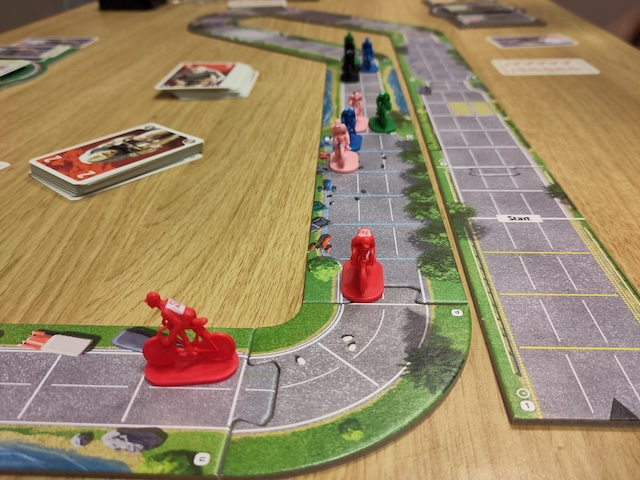
Heat: Pedal to the Metal is the follow-up to Flamme Rouge and moves to a racing car theme, adds some other cool ideas (some of which have been ported back to Flamme Rouge in the most recent expansion) and is also an excellent racing game. Honestly it comes down to theme as to which you will like best (if either at all of course).
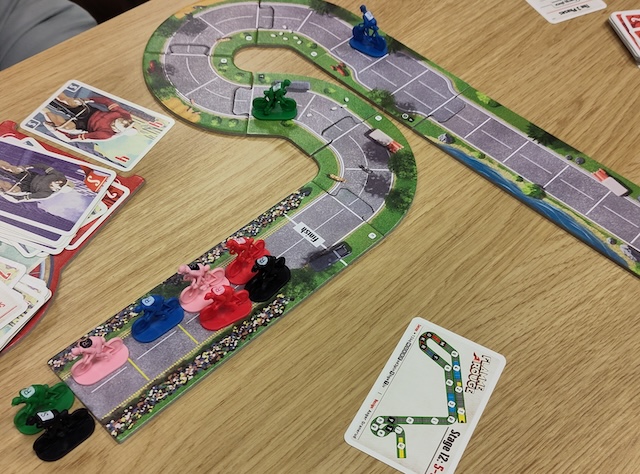
The race was the usual arc, early bunching of riders and then a few breakaways. Coming into the last third of the course the exhaustion cards start to mount up and choices become harder. All the way to the final corner it was unknown whether the riders legs were still fresh enough to push for the win. The in-game photos speak for themselves, with Simon in the Green, Jeremy in Pink, Iain in Red, Neil in Blue and Graham in Black.
The next session is the 24th of June, do come along and join us, bring some of your favourite or new games or suggest what you would like to play in advance on Discord and we will see what we can arrange.
- Total Session Attendance: 17
-
Board Games: 7