27th May 2026
On a hot May evening the air-con at the Corn exchange was most appreciated as 12 gamers tackled railway building in Germany, world domination and colonising the solar system.
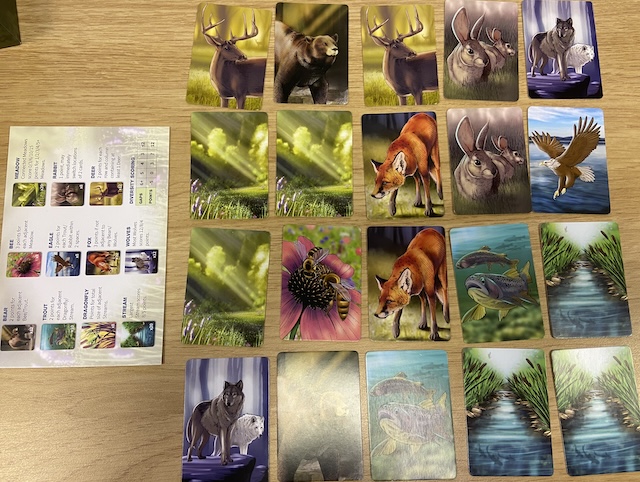
Ecosystem, the clubs most popular game, now played at 31 sessions was back, and had 2 rounds as we introduced a new player to this environmentally themed tableau building game. Soon we were wondering where all the bees were and trying to cope with fox placement (they can’t be near bears or wolves) as 4 players tried to buld the best and diverse meadow and stream habitats. Previous experience was obvious in the scores for the first round but the second game was much closer and this was a nice brain warm-up as we waited for the final player to arrive and choosing the long game.
‘Neil of the Dead’, as Steve has christened him, sought to undermine his alleged penchant for zombie games by setting up Terraforming Mars with the Colonies expansion. He was joined by Dan, Iker and James for the club’s 11th play of Jacob Fryxelius’ 2016 strategy game, last seen at session 118, and the first play of Colonies.
Terraforming Mars sees players controlling corporations which, over multiple generations (rounds), increase the temperature, oxygen level and oceanic area of the red planet. In the process they generate several types of resource, place tiles on the Mars map, and build a table-strainingly large tableau of project cards that increase resource production, unlock ongoing benefits or score victory points.
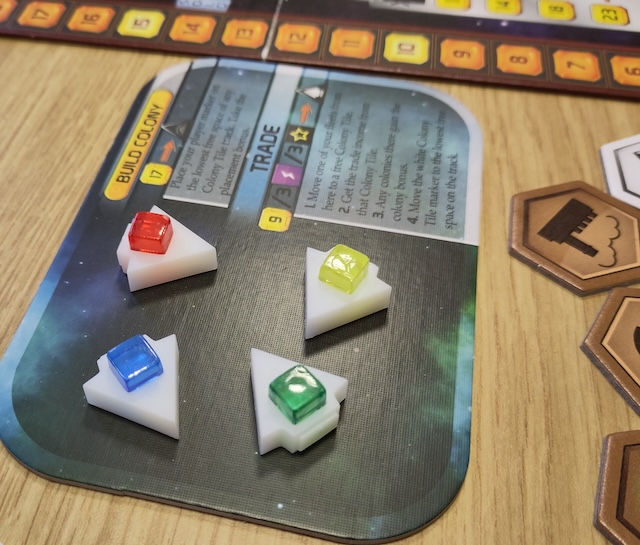
Colonies adds a number of moons and other bodies from around the solar system, on which players can pay to build the eponymous outposts. Each player starts with a single trade ship, which they can send to visit one body per generation by spending money, energy or titanium. The visitor receives trade income, while the owners of any colonies there receive a bonus. The available trade income increases with time and the number of built colonies, but immediately drops down after a visit.
The colony locations in play for this outing were Earth’s moon (offering financial incentives), the asteroid Ceres (peddling steel), Neptunian moon Triton (titanium), Uranian moon Miranda (animals), and Jovian moons Ganymede (plants) and Europa (various).
For their corporations, Dan and Iker respectively chose the base-game options Saturn Systems (which benefits from Jovian projects) and Helion (which turns heat into cash). James and Neil opted for expansion corporations Arklight (which accrues and scores for animals) and Stormcraft. This last accrues floaters - fortunately not the kind from Uranus, but a new resource for Colonies, representing craft which harvest atmospheric gases to produce heat.
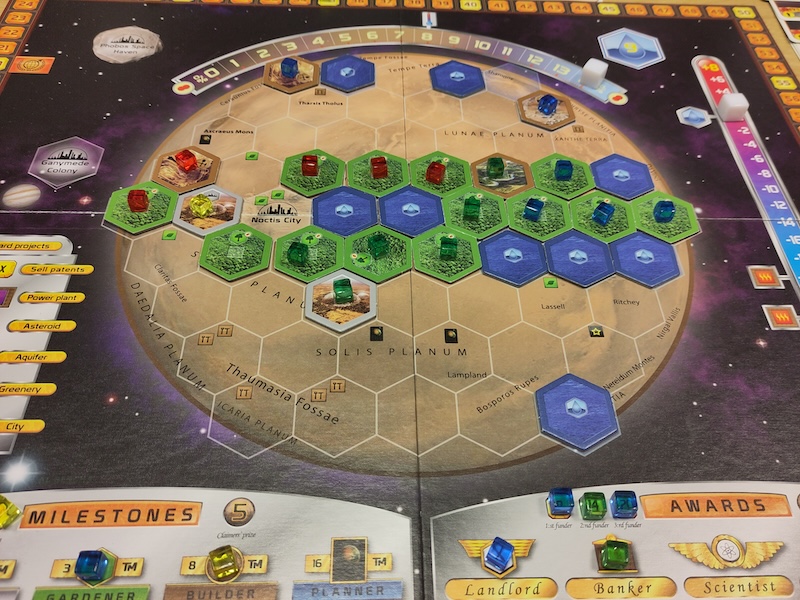
Early in the game, Iker remarked that he and Dan, the two less experienced Martians, had already played a large number of project cards compared with veterans James and Neil. Neil had embraced the expansion aspects of the game, quickly building two colonies and steadily producing floaters (so to speak), but later found this engine somewhat lacking. Iker and Dan continued to grow their tableaux, using their corporation abilities to ramp up their cash generation. Meanwhile James was quietly building a magnificent menagerie, acquiring animals using not just his corporation ability but a colony on Miranda and project cards too. Then he dropped a bombshell, playing a card that increased his income for every science tag on the table. Said tags were numerous, and James was soon coining it faster than the Royal Mint.
But as Mars’ temperature, oxygen and water rose towards their endgame-triggering maximums, it was Dan’s score marker that was far ahead of the others. Would the endgame scoring reshuffle the leaderboard? James’ space zoo certainly sent him snapping at Dan’s heels, but the CEO of Saturn Systems kept his lead by just three points. The other two Martians languished much lower down, leaving Neil wondering if he shouldn’t have played a zombie game after all.
Do you have what it takes to become a global economic powerhouse? Do you possess the ability to improve international relations around the globe? Do you want to roll your tanks into every other nation? Then maybe World Order is for you. This is an economic-political game from the team behind Hegemony set in 2010, with players taking on the role of a global power (USA, EU, Russia or China) aiming to increase their influence around the world.
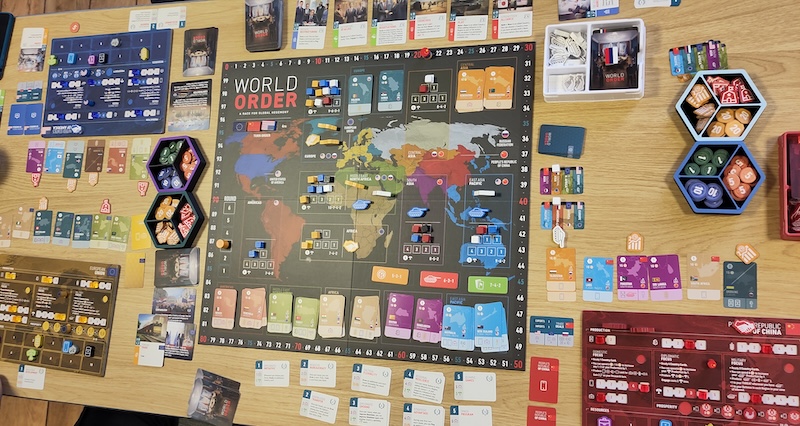
Over 6 rounds players will try to use a mix of diplomacy, economic growth and military might to gain prominence as a true superpower, utilising the magic of deck and hand management. Roles are asymmetric, with China focused on production and economic growth, Russia being very militaristic, the EU having strong diplomacy, and the USA having the capability to be good at all of these. There are a number of resources to juggle, all tracked on your player board, which also shows you your production levels for each and your current focus (Domestic, Diplomatic or Military). You start with a deck of 12 cards, 6 of those in hand, which determine your available actions each round. The main board is a map of the globe split into 7 regions, each region having a grid for influence markers and a related draw pile of cards denoting the countries in that region.
Each round has three phases – Preparation, Action and Aftermath. Preparation involves drawing your 6 cards from the top of the deck, revealing the countries that are available for interaction in each region, determine turn order, producing primary resources (oil, raw materials and food), and deciding what your focus is this round. This will then determine your production of secondary resources (goods, services, diplomacy and armies) and what bonuses you have. Action is where the cards are played (in turn order, if you remember that you have changed turn order and don’t just continue going clockwise), with most cards being played in front of you to be shuffled and re-used later. These cards are aligned with the three areas of focus and allow you to take related actions. Diplomatic cards may allow you to ally with a country, or increase your influence in an area, Military cards might let you build bases or move your tanks around the globe, and Domestic cards will focus on trade, production and economic actions. After 4 turns have been taken there is a chance to do research with any cards left in your hand – buying new cards to add to your deck. In the Aftermath players will get a return on investment if they’ve invested in any countries, will check threat levels from any other players in their areas of interest and can increase their prosperity if they have enough goods on their board (this is an ever increasing number each round).

There’s a scoring after rounds 3 and 6, which involves area control using influence in each region, along with bonuses for most armies, most money and most countries allied with. After 6 rounds one player will emerge as the global leader to be contended with throughout the remainder of the 2010’s.
Having had a learning game at the weekend Steph, Steve and Darren were keen to try again, hopefully having some vague ideas on how to play now. Jyo had to bow out at the last moment meaning the auto-opponent stepped in to control Russia – a card would inform us where they would move tanks into and who they would trade with each round. With one game behind them, they all stuck with the same power they had previously tried, to see if any learnings could be applied, with Steph taking USA, Steve being the EU and Darren leading China. Steve made a strong start, making several allies across Europe and the Middle East, and moving quite a lot of tanks into Europe – ostensibly for “peace-keeping purposes”. The United Steph of America had similar plans, but with a few less allies and a few more tanks. China decided it was best out of the arms race and instead sold a bunch of phones to increase their coffers and then built a bunch more with an eye on prosperity. Tanks continued to roll into Europe and the Middle East, although it was partly to offset the threat of Russian tanks moving in at the end of the round – both regions being of interest to all three powers, although EU and USA tanks don’t constitute a threat to each other thanks to NATO.
No-one lost any points in the Aftermath and China’s decision to stockpile phones paid off as they advanced up the Prosperity track. Steph and Darren had also managed to invest in some Growth cards granting ongoing bonuses. The next couple of rounds saw Europe and the Middle East teeming with tanks, a terrible tank tsunami sweeping soullessly across stupendous swathes of the sphere. Meanwhile China continued to produce phones, lovely shiny phones, much needed by the global populace, even though the brash Americans tried to dismiss them as just rocks and the Otterpean Union (Ed: Steve the Otter) insisted the Swiss cuckoo phones were much better. Darren continued to ignore the military nonsense, and by continuing to stick with Domestic focus had been able to research some handy cards that let him up his Prosperity levels, trying to play into China’s strengths. Steve had managed to gain an amazing array of allies, either oblivious to his wanton tank usage, or perhaps cowed by it. Steph was dropping influence cubes across the map as Americans wheedled their way into every government house.

Half-time scoring was reasonably close (for given values of reasonable and close), although some of it took place just after half-time as we forgot at the time, what with time waiting for no man and all that. And shortly after that we realised that we had been playing in clockwise fashion all game, even though turn order had been switched a few times. It’s a learning game.
The second half saw a bit more expansion, with USA making some moves in Asia, along with AutoBot Jyo (Russia was winning the number of tanks, just as it had under Jyo’s control, which did amuse the others) and China trying to throw the odd influence into the yellow and blue masses around Europe in an effort to score something for having a presence. China almost switched to a Military stance just to combat the encroaching tanks, but decided to try Diplomatic means instead, having been almost entirely focused on the economy for most of the game. Both USA and the EU had switched into military at least once, mainly in order to produce more tanks to send into the seething hordes already out there. Having reached maximum Prosperity early on China now found its economic growth slowing somewhat in terms of points and was desperately trying to figure out the maths on various card combinations hoping to get a bigger treasury than the EU via canny trading for a few more endgame points. There were some last-minute tank movements from USA, letting the Russians threaten them in South Asia in return for bolstering Europe and the Middle East.
The dust settled, points were tallied and a victor emerged. The United Steph of America would lead throughout the 2010’s, with 159 points, Steve was hanging on to her coattails with 154 and DC’s China ended at 124. A very fun play-through, and some interesting insights into deck management and timing of gaining influence, although all had played to their respective strengths a lot better than in the learning game. All were looking forward to trying it again, with a switch in powers played.
Prussian Rails, one of Simon’s many cube rails games, had its second club play, first played in session 101. This is a game of rail company share acquisition and then making dividends by connecting rail routes to other routes on a hex map themed around Germany. There are 8 rail companies available with 3 shares each. At the start of the game 1 share in each company is auctioned and with this being a 5 player game that meant 2 people only got 1 share initially, but then had more cash available for the next phase. The companies each have different perks that make laying track easier or harder and start in different cities, some being closer to the higher point scoring Berlin. The other key mechanic is that each round has 5 turns and who gets those turns is decided by putting tokens of your player colour in a bag, the number you can add determined by your current score/ stock worth, less score = more tokens and hence more likely to get one or more turns.
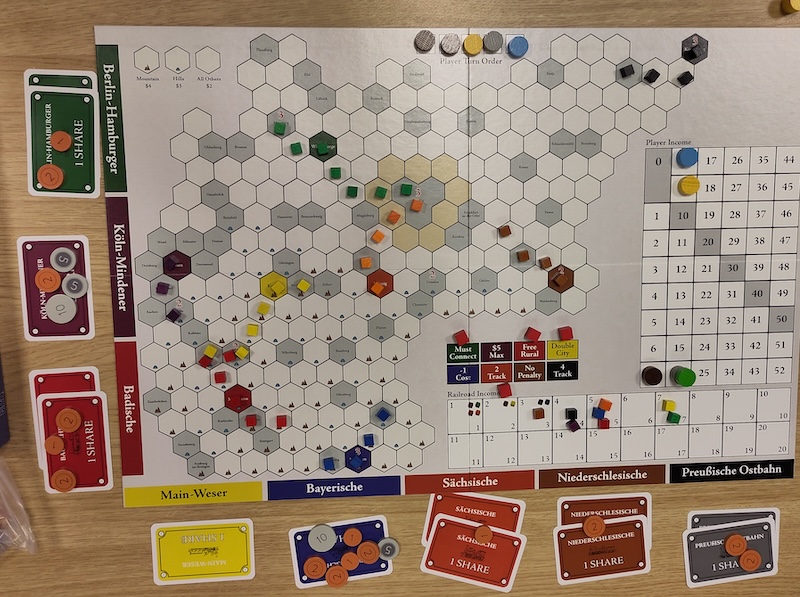
Simon being game teacher and most experienced player went with a 1 cheap company initial strategy hoping to get 2 turns in the first round and get his green company linked to Berlin and racking up regular scores from every dividend. This backfired as he got just 1 turn and Kathy was able to connect her orange company into Berlin first. Jeremy also started slowly due to some unlucky bag draws in the early rounds but still managed to acquire some new shares from auctions initiated by others. This is the type of game where with some shrewd investing you can actually do rather well without laying any track at all! Dave was building up his company influence in the South of the map and steadily accumulating stock throughout the game. Will managed to get his token drawn at least once in all but 1 rounds giving him the chance to extend tracks in his favour and start auctions for the remaining shares and he acquired 2 shares in the black company that was to prove important for the endgame.
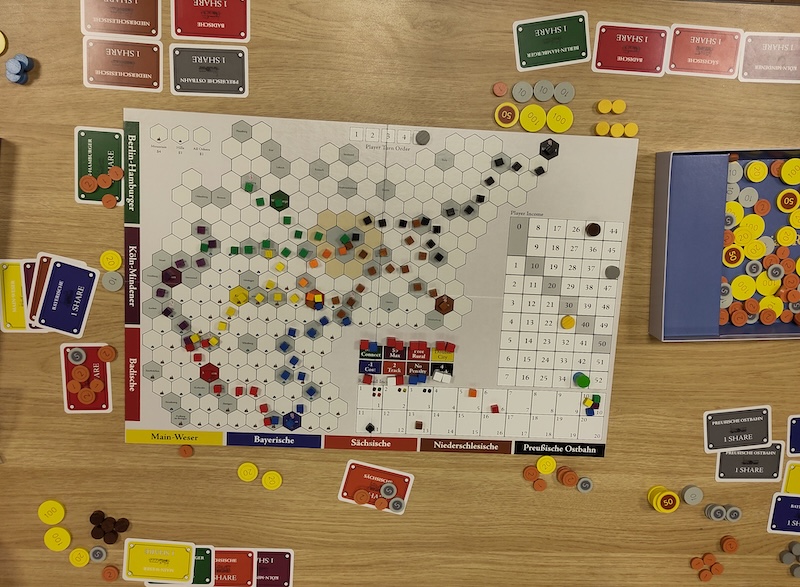
Kathy achieved some nice dividends mid-game from the purple and red companies but investing in green did not bring as much return as hoped for. Simon remained unlucky with the bag draws whilst in the final round Jeremy lucked out with 2 back to back turns which he used to trigger some nice final dividends in his favour before Will made the final connection to end the game. In the final accounting it was a win for Jeremy with Dave and Will close behind all making more than 300 cash (everyone started with 24), Kathy was in the high 200’s and Simon pulled up behind with just over 200.
Next session is on Wednesday June 10th 7.30pm at the St Ives Corn Exchange. Lots of varied games will be on offer on the night or discussed in advance on Discord, if you want to suggest a favourite and gets others signed up for a space at the table.
- Total Session Attendance: 12
-
Board Games: 4